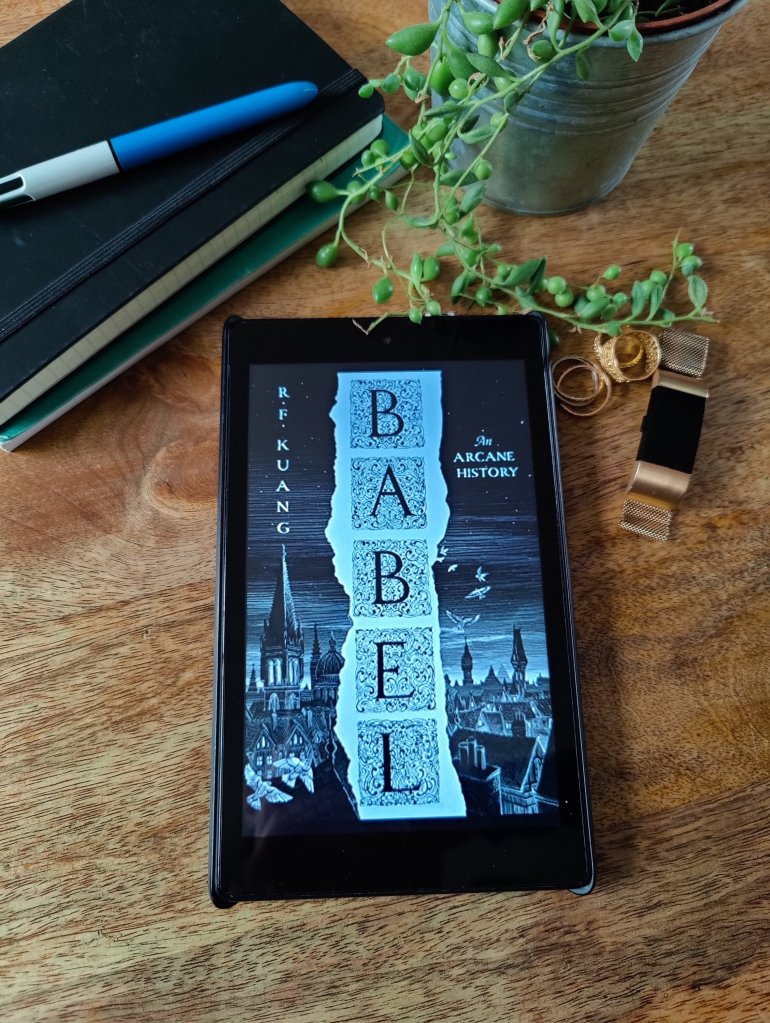
Since finishing Babel and professing my undying love to it, I’ve spent much of my time conversing with other readers about exactly what I loved and why, as well as trying to convince a minority of readers that this is definitely worth the time and effort. (its a whopping 560 pages or 21 hours and 45 minutes if you choose to listen to the audiobook, as I did). It’s not an easy book to write a review about because much of what I thought was brilliant would also constitute a spoiler, and I certainly wouldn’t want to ruin this epic for anyone.
Primarily set in Oxford in the 1830’s, Babel is speculative fiction that explores the evils of empire and colonialism through the magic powers of silver and language. Matching words are inscribed on silver bars from multiple languages thus giving them power. These ‘match pairs’ are used in all industries; from agriculture, powering trains, to healing and for basically everything that keeps the Empire going through magic called “silverworking” as a professor at Babel explains: “the stuff of language that words are incapable of expressing—the stuff that gets lost when we move between one language and another. The silver catches what’s lost and manifests it into being.” Babel, which is the head quarters of the translation industry, is a tower where scholars work and every year a new cohort of students are recruited from all over the world, with expert language skills in their native tongue as well as English to source increasingly powerful pairs.
Robin Swift, the main protagonist, is bought to London from China, at the age of 11, by Professor Richard Lovell after the mysterious death of his mother. He has opaque memories of his childhood but remembers an uncles addiction to opium and that leading the family to poverty. Living with the professor he has a strict schedule of schooling which includes learning Mandarin, Latin and Greek. Professor Lovell is a senior staffer at Babel and a staunch imperialist. When Robin arrives in Oxford he meets his fellow Babel students: Ramiz Rafi “Ramy” Mirza, a Muslim student from Kolkata, Letitia Price, or Letty, the only British Student and daughter of a former admiral and Victoire Desgraves, originally from Haiti but raised in France. The four become fast friends and rely on each other as they experience the intensity of learning languages and the racism of Oxford and the Empire.
Using language and the power of translation as the “magic” that keeps Empire running is an extremely clever way to portray colonialism and its theft of resources, including people. I really appreciated the way R.F. Kuang wrote about the internal struggle of some of the characters working for the empire and benefitting from it, whilst at the same time knowing that many of their countrymen were suffering. There are conversations about gratitude and guilt, that will resonate with every person of colour in some way as well as the idea that because of our expected gratitude we are not allowed to be critical of anything without appearing ungrateful. Using the setting of Oxford University, and centring education, with its history of elitism, and with that institution benefitting financially from colonialism, as well as training colonial administrators, was an excellent choice of setting for me. I must confess that I have very little knowledge of The Tower of Babel from biblical literature, so whilst some think that calling a tower that deals with languages Babel, is too on the nose, I would argue that not all readers are familiar with Christian theology and even for those that are, its not off putting enough to discourage reading. I personally think its quite a clever link, tying religion into the web of colonialism.
Speaking of religion, and as a Muslim reader and reviewer, I thought the Muslim representation in Babel was far superior to many of the “Muslim” books I’ve read. I absolutely loved Ramy and completely echoed his entire vibe. He knew his history and the many contributions (read sacrifices) his country and people had already made for the empire. He was so well written and such a thoughtful character. I loved his convictions and I admired his choices. Although there is no romance in Babel, there is a moment when one of the characters is found to harbour “fondness” for Ramy. Near the end of the novel Ramy’s rejection of this is rationalised and its so on point and completely accurate that I wanted to get up and applaud it. I won’t go into it as I don’t want to spoil any of it for readers who have yet to pick up and delight in the text, but yes, Rami was my favourite.
One of the questions I get asked frequently about Babel is what other book is it like. Although I enjoyed Yellowface, I know many thriller readers who didn’t, possibly because they read it with different expectations. For me the thriller element of Yellowface was less interesting than the overall message of the book. Yes, the ending was a little farcical and predictable, but I was willing to forgive that as I really enjoyed the social commentary and the contemporary analysis of the publishing industry. If I was to compare Babel to anything it would be The Secret History by Donna Tartt (which I loved) mixed with a little Harry Potter (although I have to confess I haven’t read HP or seen any of the films!) Although the two might feel like an odd mix, they both excel in there own genres. Babel is that rare book that appeals to a wide spectrum of readers as it successfully crosses and mixes genres to tell an extraordinary tale of magic and reality. Its use of footnotes and scholarly information and quotes enhances the readers experience. It has absolutely everything that makes reading a delight.
I’d love to hear your thoughts on Babel if you’ve read it and if you haven’t, what’s causing your delay?
 This Hybrid Reads
I loved it so much, I ordered it in Paperback so I could read it again rather than on my kindle, and wondering if I should get the audio as well to complete the set!
LikeLike