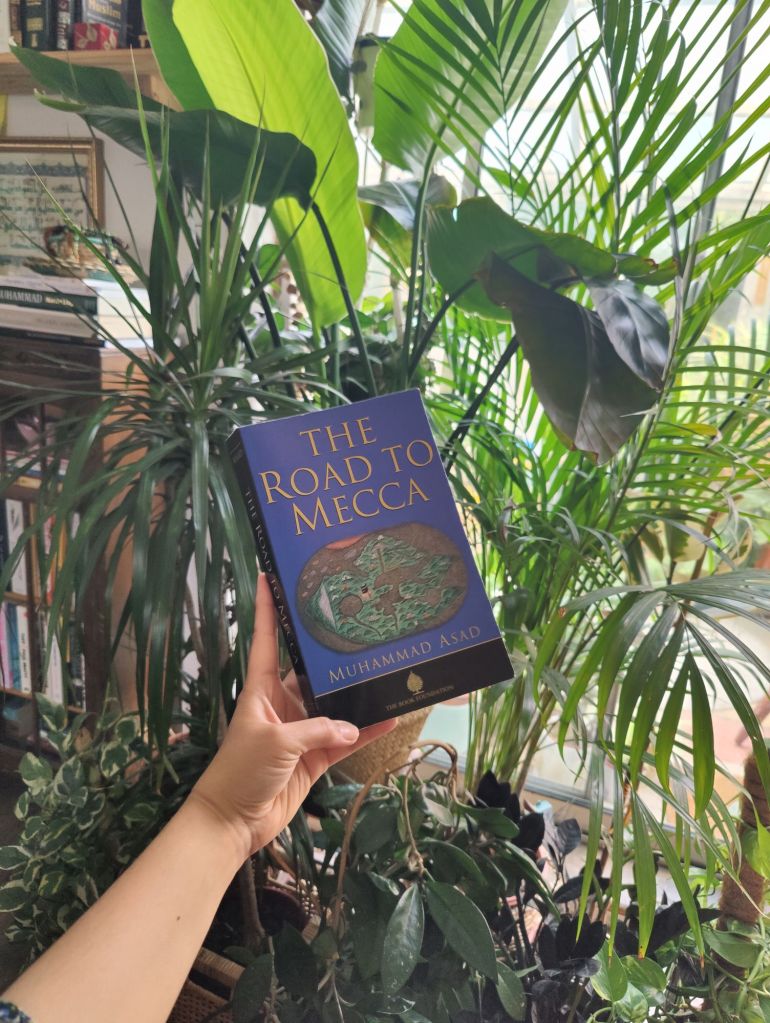
The Road to Mecca is a fascinating autobiography by Muhammad Asad. Written in 1952 it covers an extraordinary period in world history from 1900 to 1932, where many in Europe are shaking off their religious identity and moving into the 20th century worshiping Capitalism. Asad, born Leopold Weiss, grew up in the Polish city of Lwow, modern day Lviv, in Ukraine. He was raised in a Jewish family, and although his parents were not religious he was required to study the sacred scriptures, and so by the age of thirteen he was fluent in Hebrew, Aramaic as well as Polish, German and English. This foundational understanding of Judaism led Asad to move away from the religion as he describes: “the God of the old Testament and the Talmud was unduly concerned with the ritual by means of which His worshippers were supposed to worship Him. It also occurred to me that this God was strangely preoccupied with the destinies of one particular nation, The Hebrews. The very build-up of the Old Testament as a history of the descendants of Abraham tended to make God appear not as a creator and sustainer of all mankind but, rather, as a tribal deity adjusting all creation to the requirements of a ‘chosen people’: rewarding them with conquests if they were righteous, and making them suffer at the hands of nonbelievers whenever they strayed from the prescribed path” but it didn’t supress his curiosity and yearning for spirituality. At the age of 20, after serving a short stint in the Austrian army at the end of The Great War, he boarded a train to Prague, hoping to pursue a career in Journalism.
The following year is full of incredible hardships but also wonderful opportunities: from working with Hollywood film director F.W. Murnau and Viennese journalist and script writer Anton Kuh, to periods of extreme poverty. He receives a lucky break in 1921 whilst working as a telephonist for United Telegraph. A chance meeting with Madame Gorky, the wife of Maxim Gorky, leads to a first class scoop and his first job as a journalist. It’s as a journalist he finally gets to travel to the Arab world and where he learns about Islam and its people,
Asad shares his adventures in a nonlinear narrative. The book starts in the desert of Arabia, with him and his companion Zayd, at the end of their mission, and heading back to Mecca. It is composed of 12 chapters and Asad’s writing is without exception stunning. From his descriptions of the landscape of the desert to Bedouin tribes and people to his explanations and understandings of politics and the human condition, he writes with beauty. From the desert we move to Europe as Asad reminisces his past and the paths that led him to the present moment. There is an effortlessness in the flow of the narrative that makes the time the reader spends with this book similar to the description of time in the desert, you lose yourself entirely within it . I’m tempted to fill this review with passages from the book to illustrate its allure, but I don’t want to deprive you of the joy of reading them for the first time.
The book is written in old English, and has all the romanticism of history, although this is not deliberate as the author is incredibly critical of the direction he finds the world going in. Many of the countries in Arabia were colonised during this period, and the world map as we know it today had not been marked up, so the geography and names of countries, as well as their political allegiances, are different. I found this aspect of the book absolutely fascinating. Arabia has yet to discover oil and Europe is having an identity crisis after the catastrophe of the Great War. The Juxtaposition of these two worlds, one still steeped in spirituality and religion the other worshipping creature comforts with its temples of faith becoming factories, cinemas, laboratories and its priests bankers and politicians, is in some ways a stark contrast to what we see today, particularly in Arab countries. Asad’s description of people in Europe really resonated with me: “While none of us was really unhappy, only a few of us seemed to be consciously happy”. This is one of the few nonfiction books from the early 20th century that has aged well, and still rings true for our quest for meaning in a Capitalist world void of God.
Asad’s first trip to the Arab world is to Palestine. In 1922, before the Zionist occupation and the creation of Israel, he visits his uncle Dorian and stays in Jerusalem. The Balfour Declaration was signed in 1917 and the author writes briefly about this cruel political manoeuvre. It is striking how contemporary many of his arguments against the occupation are. He writes about the influx of Zionists from Europe and how starkly they stand out from the Jews native to the land. He also writes about the hospitality of the Palestinians and his first experience of hearing the call to prayer and the rituals around the prayer in this beautiful ancient city. Knowing that Al-Aqsa was the first qibla (direction of prayer) for Muslims, and having his journey to Islam begin in this sacred land is the kind of poetic symmetry that fills the pages of this book. He also debunks the notion that Palestine was uninhabited, and describes its bustling streets and market places and the incredible generosity and conviviality of its people. If you don’t read the whole book, then the chapters Winds and Voices are the ones I recommend. They will steal your heart.
From Palestine Asad moves on to Egypt and then to Transjordan and Syria. The descriptions of the Muslim world are unlike anything I have ever read, and unfortunately probably lost to the past. The rich heritage and melting pot of cultures, with people from Türkiye, Niger and Lebanon all contributing to the warmth and love the author clearly has for the region. He describes the subtle changes in inflection as well as the attire and foods as he moves from one place to the other, and the reader can feel his heart opening to the possibility of a life outside of Europe. In Syria he reads books about Islam as well as the Quran in translation in both French and German. He observes that Islam is unlike other religions in that it is more a way of life “not so much a system of theology as a programme of personal and social behaviours based on the consciousness of God.” The way that Quran and hadiths are weaved into the text and explained in practical terms is a real joy to read. The author speaks candidly about his concerns as well as his wonder, and compares Islam to both Christianity and Judaism in the most fascinating ways.
Not only is this book an intriguing look into one mans journey to Islam it is also a captivating read about the modern history of Islam and the countries that make up the Muslim world. Stories about King Abdullah of Jordon, Mustafa Kemal in Türkiye and of course King Abd al-Aziz ibn Saud, who becomes a good friend of the author, are narrated throughout his travels. So many of these characters go on to have pivotal roles in the changing landscape of Arabia, many of the consequences we are still feeling today.
I really can’t recommend this book enough. Not only does it have a captivating and enthralling plot, it is beautifully written with effortless style and warmth. It has a cast of characters that we grow to love and it builds a world that is both familiar and unknown. His observations are clear and sharp, critical and nuanced. This is without doubt the best autobiography I have ever read, but it is also outstanding as a story and as a geopolitical and socio/spiritual text. How one book can serve so many needs is the mastery of Muhammad Asad’s writing. You really do have to read it to believe it!
 This Hybrid Reads