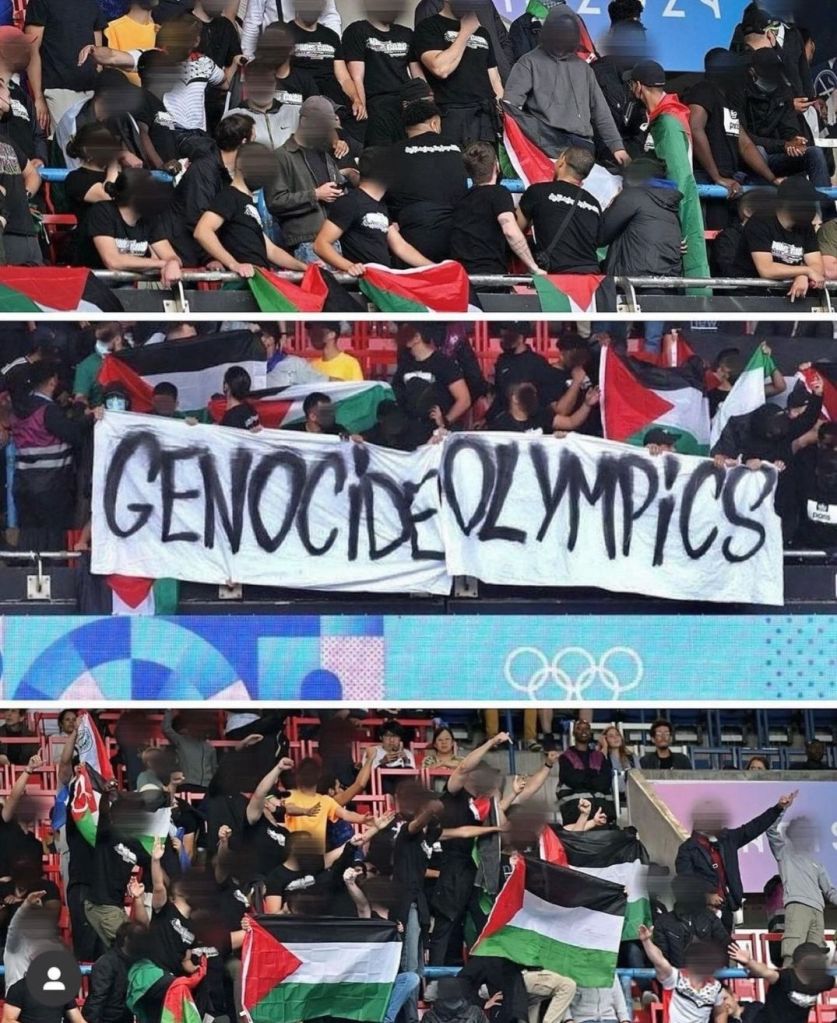
Last Friday Paris officially launched the Summer Olympic Games. As 10,000 athletes welcomed in the beginning of the tournament, waiving the flags of their respective nations, there were two striking absences, Russia and Belarus. Both countries have been banned due to Russia’s invasion of Ukraine in 2022. There was also one conspicuous inclusion, Israel. Apparently its occupation (or invasion) of Gaza, its Apartheid policies and the investigation by the International Court of Justice into its probable genocide in Gaza, don’t disqualify it’s athletes/ occupation forces from taking part. How, you may wonder, did the International Olympics Committee (IOC) come to two such contradictory conclusions.
The decision to ban a country from the Olympics lies solely with the IOC. The first modern Olympics were held in 1896, and in the sports 127 years, thirteen countries have been banned from participating. The first ban was issued in 1920 to five countries, Germany, Austria, Hungary, Bulgaria and Türkiye, for their role in the First World War. Germany was also banned in 1924 and 1948, along with Japan, for their role in the Second World War and South Africa was banned from participating in the games from 1964 to 1992 for its racial segregation and Apartheid. Zimbabwe (then named Rhodesia) was banned in 1972 for its policies of racial segregation. In 2000 Afghanistan was banned due to the Taliban and their views on women. (Interestingly, France isn’t banned from this years Olympics although it refuses to let women who chose to wear hijab participate – so apparently only the west is allowed to impose laws on women’s bodies!) In 2015 Kuwait was suspended from the games due to the governments interference in the countries Olympic committee. And in 2022, North Korea was barred from the games due to its refusal to send a team to Tokyo, two years previously citing COVID concerns.
Whilst the IOC and other sports bodies, most noticeably FIFA, continue to pay lip service to the notion that they are not political, in reality, as every one of the decisions above highlights, they are deeply steeped in global politics. They are only apolitical when it suits them. Sports by its very nature is political because humans are political. To divide sports by gender is a political decision. Access to certain sports is political, that’s why richer nations tend to have sportsman(people – because language is also political) in every category whilst poorer nations are underrepresented. The nation state is a political construct and therefore requiring participants to represent a country is political. Race is political.
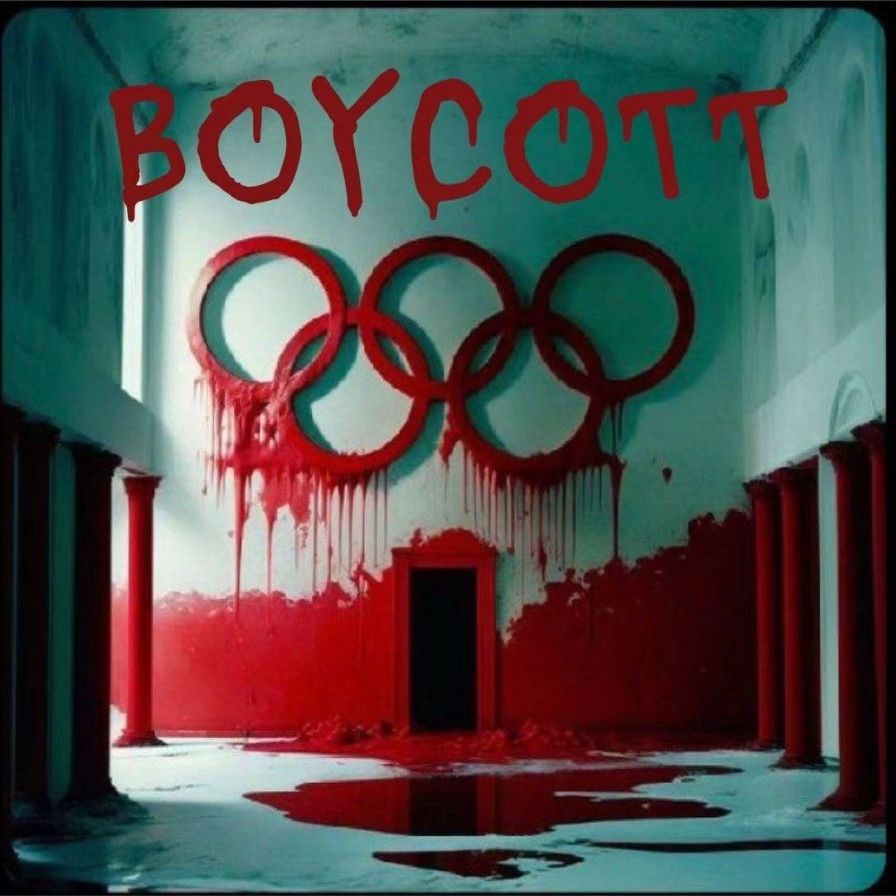
Although I’m no fan of the original Olympics, with its thirst for blood and misogyny, they were essentially a celebration of extraordinary feats of athletic endeavour. The Olympics were also a religious festival where animals were slaughtered to honour Zeus, King of the Greek gods. The games came to an abrupt end with the advent of Christianity in Europe when in 393 AD, the Christian emperor Theodosius I forbade the celebration of pagan cults, which included the Games. When the games were revived in 1896, in the height of European colonialism, only 14 nations took part, all European with the exception of America. Women were allowed to compete for the first time in 1900, but only in 5 sports and of the 997 athletes, only 22 were women. In the early part of the 20th Century the games were steeped in racism reflective of the culture of the time. The games in 1904 even consisted of a racial experiment, devised by the games director James Edward Sullivan, designed to prove “the savages” (read: anyone who isn’t white) natural athleticism was inferior to that of ‘civilised’ white people. This tawdry sideshow was called ‘The Savage Olympics’. It was only after 1940 that African and Asian countries began to join the Olympics in significant numbers, as they gained their independence.
Whilst some countries have been excluded from the games on the basis of war and conflicts, others have never been. Both the United States and the United Kingdom were allowed to participate in the games in 2004 whilst invading Iraq under the false pretence of weapons of mass destruction. The UN also described that war as illegal. It’s estimated that one million Muslim Uighurs have been detained in camps and prisons in Xinjiang, Northwest China, this blatant pogrom of persecution, abuse and forced training to abandon the “evils of Islam” have been described by multiple human rights organisations as well as the United States as a form of genocide, an yet they continue to be allowed to participate.
The Olympics have always been a reflection of what’s happening in the wider world. Post the Second World War, and as more nations from outside of Europe and American began to participate, the cost of hosting the games and bidding for the games also increased. The success of the Los Angeles Olympics in 1984 led to an increase in other cities also wanting to host and replicate the financial benefits of Los Angeles, this allowed the IOC to pick the city with the most ambitious, and most expensive, plans to host. The costs of the games have spiralled. The 2014 Winter Games in Sochi cost over $50 billion, $20 billion for 2016 Summer Games in Rio de Janeiro, and a reported $39 billion for the 2022 Winter Games in Beijing, according to Business Insider’s estimate. (China said the games cost just $4 billion). These eye watering amounts have now led to countries withdrawing their bids. In 2021, Brisbane, Australia, the 2032 Summer Games’ host, became the first city to win an Olympic bid unopposed since Los Angeles did so in 1984.
The economics of the Olympics is a clear sign as to its politics and it’s disingenuous to imply otherwise. The IOC is afraid to offend wealthier nations at the risk of losing funding and acts according to their interests. In this age of global Capitalism, with big businesses and lobby groups essentially having more of a say in our democracies than the people voting, it’s clear that politics is very much at the heart of everything. Palestine has opened our eyes to the blatant hypocrisy of everything around us, from the notion of equality and freedom to democracy and the rights of the people. The disease of our time is wealth. If you are rich enough and have the backing and support of wealthy doners, than yours is the world and everything in it, and which is more, you can commit genocide and continue to participate in sports, even as you sign the bombs that are dropped on innocent children and have the blood of at least 200,000 Palestinians on your hands.
I for one won’t be watching the Olympics this year, my eyes will be fixed firmly on Gaza and Palestine.
 This Hybrid Reads
My eyes will always be firmly on Israel who is defending itself against a genocidal terrorist regime (yes, Hamas want to eliminate Israelis / Jews).
LikeLike
I hope your eyes are on Israel as they are debating whether it’s legitimate to sexually assault and gang rape children, women and men. If that’s a society you advocate for, you are the problem. No wonder you hide your identity, deep down, even your ashamed of who and what you are.
LikeLike