I had convinced myself that I had read Orientalism two decades ago, so I wanted this to be a quick recap before I started on Restating Orientalism by Wael Hallaq, the book I wanted to give my time to. However, when I started reading it, almost a month ago, I realised that I had imagined my previous reading. Nonetheless I have to confess I did skim read the first two Chapters (yep, it still took me a month!) in which Said explores the scope of Orientalism through the study of language, literature and anthropology from the 18th century onwards. His main focus is academic works of philologist’s from Britain, France and Germany and those whose work focuses on the languages and cultures of Southwest Asia and North Africa.
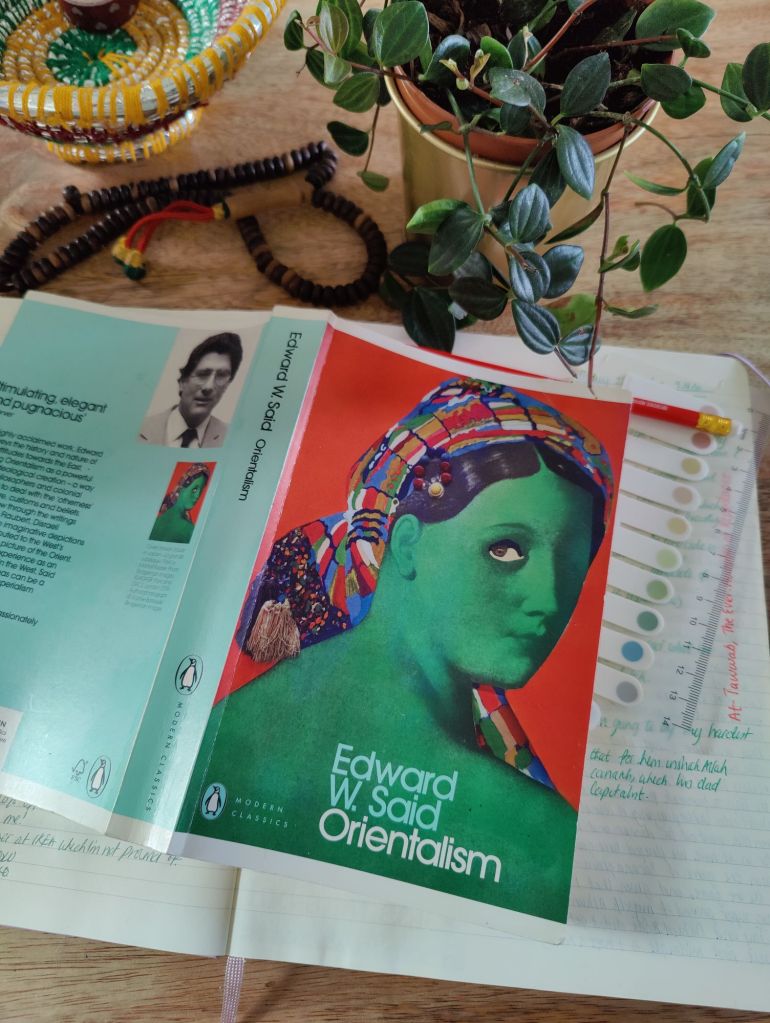
In excruciating detail he demonstrates how these scholars contrived their highly selective, biased observations into supposedly “scientific” findings, thereby positioning themselves as objective authorities on the “Orient” Said also explores the work of authors, poets, painters, philosophers and politicians, citing figures as varied as Arthur Balfour, Victor Hugo and Eugène Delacroix. It is striking to me, as a reader, how much of the literature and learning I’ve consumed over my lifetime has been written by the hands of these orientalists: Camus, Marx, Dante, Foucault, Verne. Although Said doesn’t mention it, I’m reminded of the depiction of the Muslim characters in Mary Shelley’s Frankenstein, which I reread two years ago, as a more conscience reader. It reeked of Imperial and racial discourse from the 18th and 19th century. I don’t recall any discussions on the blatant Islamophobia when I studied this text almost 20 years ago.
The final chapter of the book explores Orientalism Now, and is by far my favourite section. Said explores modern Anglo-French Orientalism, and it’s again terrifying how many of the examples are relevant forty-six years after Said wrote his magnum opus. In it he demonstrates the continued condemnation of Islam, and the lengths, particularly by the Americans, Orientalists are willing to go to construct not only a narrative, but also institutions, to establish their ideas of the Orient.
It is staggering to think that the Occidental powers have spent almost four hundred years trying to demonise and alienate Islam and Muslims. As Said points out, the West’s obsession with the Orient isn’t reciprocated, even in the post colonial years of the twentieth and twenty first century. In fact when Said penned this book, in 1976-8, the United States was more heavily invested in the Middle East than anywhere else on earth. America has spent almost a hundred years creating a caricature of the Arab (and therefore Muslim) to suit their imperial and colonial ambitions, such as the Zionist state of Israel. So much of the language we hear today has its roots in Orientalism, and the ideas that have been indoctrinated into us via education, literature and culture.
It’s evident that the same playbook is still in circulation. Where once Muslims were called, Mohammedans, in today’s vernacular we’re “Islamist”, call us anything, but by our names! Every effort continues to be made to “other” Muslims: violent narratives around Muslim men, the alleged oppression of Muslim women and of course our desperate yearning to be part of the West and its liberal democratic values in place of our traditional “backwards” way of life. And still, we hold on to our faith.
I can’t think of a single group in the history of the earth that has had to face such a consistent barrage of intimidation and accusations. There have been, and continue to be, studies into Arabs, Arabic, Muslims and Islam all through the lens of orientalists. The Qur’an is dissected and interrogated, with verses pulled out of context and meanings distorted to suit the particular wave of Islamophobia. There has been a consistent effort for at least 400 years to discredit Islam and its followers. And yet here we still stand. Islam continues to grow and Muslims, across the Orient and the Occident, hold on to our faith. I can’t help but feel a sense of pride about that.
 This Hybrid Reads