I know not everyone will make it to the end of this review, it is without exception, my longest. As a rule I avoid star or numerical rating systems as I find them limiting in their scope. I love so many books, but I don’t always recommend them. Here is my exception. I would give this book all the stars. If I were rating it out of ten, it would be a thousand! If I was suddenly to find myself as president of the world, this would be on every reading list in every school and in every hotel room for that matter. If I could only recommend one book for the rest of my life, it would be this book: The autobiography of Malcolm X. I hope that has inspired you to pick up a copy of this timeless and crucial text, but if you need more convincing, or are curious as to why I loved it so much, allow me to elaborate.
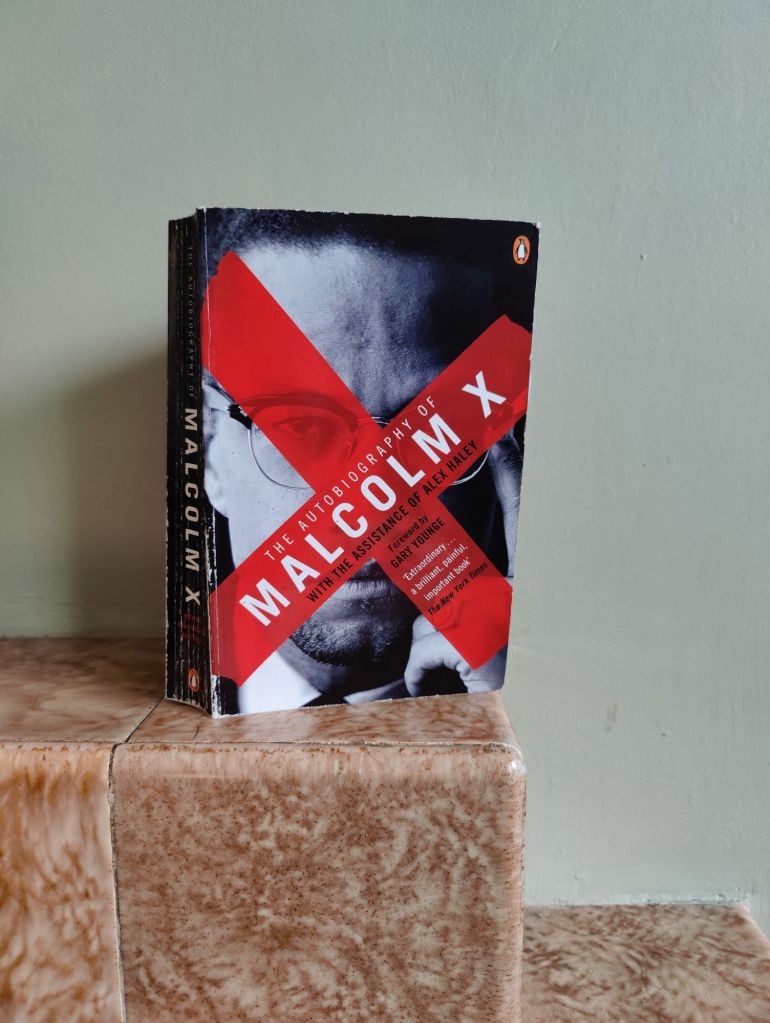
In my impatience to read the book, I almost skipped the 78 pages of foreword by Alex Haley who worked with Malcolm X in documenting his life. I’m glad I didn’t because much of Malcolm X’s personality comes through in these pages as well as his habits and traits. It is in these pages we see Malcolm as those close to him did. His attention to detail, obsession with time and his constant scribbling and making notes, conjure an image of the great Malcolm X, long before the reader gets to meet him. It is intriguing to see Malcolm through the lens of Haley, who although a few years older than Malcolm and from a very different background, clearly admired and respected him. Their time together coincided with much of the upheaval in Malcolm’s own personal journey and Haley captures those vulnerabilities and anxieties as well as preparing us for some of the shocks to come. Their conversations, over a two year period, start with Malcolm speaking mostly about Elijah Muhammad and The Nation of Islam, but become increasingly personal and candid with Malcolm even surprising himself with his revelations about his mother. The rest of the book is divided into nineteen chapters and just over 400 pages.
Malcolm’s formative years are marked by violence. When his mother was pregnant with him, she told him of a night when a party of hooded Ku Klux Klan riders surrounded their home, threatening them to get out of town. Reverend Earl Little, his father, was a Baptist minister, and follower of Marcus Garvey, who believed and preached that freedom, independence and self-respect were not possible for the Black population in America and they should therefore return to Africa. Much of these beliefs were from personal experience including the death of four of his six brothers, three of whom were killed by white men including one by lynching. Malcolm Little was born on the 19 of May 1925 in Omaha. His mother Louise Little, “looked like a white woman” was herself a child of rape and as Malcolm stated was the reason he had his fair complexation and reddish-brown hair. One of Malcolm’s earliest memories is from 1929. He reminisces waking in the middle of the night to the sounds of pistols being shot and smoke and flames. Their home was set alight by two white men and the family only narrowly managed to escape. After this incident the family relocated to East Lansing, Michigan, where black people were not allowed to go out after dark. Due to police harassment, the family had to move again, two miles out of town into the country. Malcolm also witnessed violence in the home, with his father beating his mother as well as all of his siblings if ever they broke one of his many rules. Malcolm, who was never beaten observed: “I actually believe that as anti-white as my father was, he was subconsciously so afflicted with the white man’s brainwashing of Negroes that he inclined to favour the light ones, and I was his lightest child. Most Negro parents in those days would almost instinctively treat any lighter children better than they did the darker ones. It came directly from the slavery tradition that the ‘mulatto’, because he was visibly nearer to white was therefore ‘better’” His mother on the other hand would beat him, and this he assumed was also because of his fairer complexation and how it reminded her of how she came to be light herself. In 1931, when Malcolm was only 6 years old, his father was killed. His skull was crushed on one side and it was rumoured that “he was attacked, and then laid across some tracks for a streetcar to run over him. His body was cut almost in half” The next few years of young Malcolm’s life were marred with violence of another sort. Poverty, loss and social services created the perfect storm inside his mother for her to be institutionalised and for himself and his younger siblings to be taken away to different care homes. Reflecting on this experience of society’s failure to protect his family at its most vulnerable, the hypocrisy and greed he witnessed, as well as the lack of compassion and mercy, Malcom wrote “hence I have no mercy or compassion in me for a society that will crush people, and then penalise them for not being able to stand up under the weight”
Malcolm was moved from detention centre to various homes. He stayed with both black and white families and made observations on how differently they smelled from each other as well as how differently their foods were seasoned. Although he remembered the white families treating him well he also observed how they casually talked about ‘niggers’ in his presence, in a derogatory way, as though he couldn’t or didn’t understand the meaning of the word. Of this he wrote “it never dawned on them that I could understand, that I wasn’t a pet, but a human being. They didn’t give me credit for having the same sensitivity, intellect and understanding that they would have been ready and willing to recognise in a white boy in my position. But it has historically been the case with white people, in their regard for black people, that even though we might be with them, we weren’t considered of them. Even though they appeared to have opened the door, it was still closed. Thus they never did really see me.” This struck me as such a poignant observation, and one that many of us are still grappling with today. We might not get called the n-word to our faces, but we see almost daily how the lives of people of colour are not valued in the same way as white people, especially by institutions such as the media and our politicians. Malcolm was both popular and good at school. Although faced with the casual racism of lowered expectations, he was always one of the three top students of his year, with English and History being his favourite subjects. When Malcolm was around 14 he had a chance conversation with a white teacher, Mr Ostrowski, that went on to have a huge impact on his life. When asked if he had considered a potential career for himself, Malcolm said he wanted to be a Lawyer, to which his teacher responded “You’ve got to be realistic about being a nigger. A Lawyer – that’s no realistic goal for a nigger”. This comment was made around 1940, that’s only 85 years ago. To put that in some sort of context, the idea of the “American dream” was popularised in the 1930’s, with its emphasis then on equality, democracy and liberty. In fact, the first Black Lawyer in America was Macon Bolling Allen, in 1845, almost a hundred years earlier! What is even more shocking (and sickening) though is that this statement has no doubt been made to children of colour across America, even to this day. Apparently Mr Ostrowski had encouraged every other student in the class to pursue their dreams, even though none of them excelled in the same way as Malcom, the only black student in the year.
I really enjoyed reading the next few chapters of Malcolm’s life. In many ways they reminded me of reading books by Colston Whitehead, especially Harlem Shuffle, and I’m almost certain that the author based at least some of his research on Harlem during that period on Malcom’s testimonies! Around 1940 Malcolm moved to Boston to stay with his half-sister Ella. It is here he really begins to experience being black outside of the white gaze. Boston, which was racially segregated up until the 1980’s, was Malcolm’s first experience of big city life. He saw inter-racial couples, but also noticed the class divisions within black society. He got a job as a shoeshine boy at the Roseland State Ballroom, where he was to discover his love of dancing, especially the Lindy Hop. Malcolm had many of his firsts during this period. Although he was only 15, because of his height he looked much older. He drank, smoked, including cannabis (reefers), gambled and played the numbers (an illegal lottery before the official lottery was launched). Malcolm also bought his first zoot suit “sky blue pants thirty inches in the knee and angle-narrowed down to twelve inches at the bottom, and a long coat that pinched my waist and flared out below my knees” This was also the first time Malcolm conked (chemically straightened) his hair about which he writes “this was my first really big step towards self-degradation: when I endured all of that pain, literally burning my flesh with lye, in order to cook my natural hair until it was limp, to have it look like a white man’s hair. I had joined that multitude of Negro men and women in America who are brainwashed into believing that that Black people are ‘inferior’ – and white people ‘superior’ – that they will even violate and mutilate their God-created bodies to try to look ‘pretty’ by white standards.” Malcolm speaks about his younger self in ways that reveal how charming, confident and self-assured but also how incredibly self-aware and self-deprecating he could be. There is also a lot of joy in these pages as he relives and relates his coming of age in Boston and later Harlem. So much of his later teachings and life lessons come from what he learnt on the streets as a hustler in these cities and their ghettos. Malcom wrote of these experiences “In one sense we were all huddled in there, bonded together in seeking security and warmth and comfort from each other, and we didn’t know it. All of us – who might have probed space, or cured cancer, or build industries -were instead black victims of the white man’s American social system.”
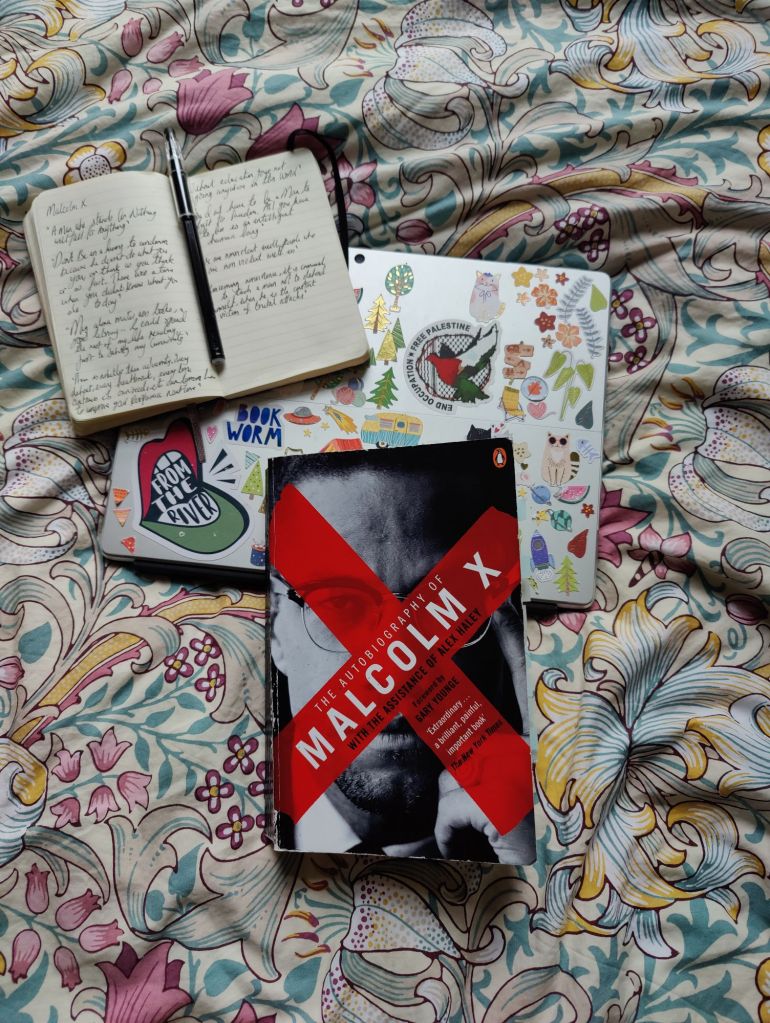
Over the next few years of his life Malcolm grew increasingly dependent on drugs and involved in criminal activities. In 1946, at the age of 21, he was arrested for burglary and sentenced to a ten year prison sentence. At this point in his life he is so far removed from any organised religion that he was called “Satan” by his fellow inmates. In 1948 he was moved to The Norfolk Prison Colony, which was an experimental rehabilitation jail. Only fifteen percent of the inmates here were black. The desire to acquire knowledge never left him, and on the advice of an older inmate he took advantage of the prison correspondence course, first in English and then in Latin. He also devoured books throughout his incarceration and at one point even copied out the entire English dictionary. His love of knowledge and language is evident in his many speeches and his eloquence is part of what makes this autobiography the bestseller it was, and why it continues to inspires millions of people, 60 years after it was published. Malcolm also took part in classes that were taught in the prison library, often by Harvard and Boston university instructors, and he took part in debates there, a precursor to what lay ahead for him. The Norfolk Prison Colony’s library was one of its outstanding features, it had books on very general subject. A millionaire named Pankhurst had donated his library to the prison, and here the prisoners were able to browse the shelves, walk up and down the aisles picking their own books. Pankhurst was interested in History and Religion and the library was full of books, which Malcolm consumed. He quips that he went into prison with 20/20 vision, but the late night reading, using the light in corridor outside his room, ruined his eyesight.
Malcolm read widely from Will Duran’s Story of Civilisation, H.G. Wells’ Outline of History, W.E.B. Du Bois Souls of Black Folks, Carter G. Woodson’s Negro History, J.A. Rogers three volumes of Sex and Race, Gregor Mendel’s Finding in Genetics and the fictitious Uncle Tom’s Cabin by Harriet Beecher Stowe. He comments on how Frederick Olmsted open his eyes to the horrors of slavery. He read topics ranging from Christianity, the Egyptians, Indian history and Britain’s East India Company, China and the Opium Wars, and of course Black History. Of this he wrote: “Over 115 million African blacks – close the the 1930’s population of the United States – were murdered and enslaved during the slave trade. And I read how when the salve market was gutted, the cannibalistic white powers of Europe next carved up, as their colonies, the richest areas of the Black continent. And Europe’s chancelleries for the next century played a chess game of naked exploitation and power from Cape Horn to Cairo.” I could probably quote the whole of the chapter titled “Saved” as its full of gems, but I want you to read this masterpiece and treasure it’s timeless wisdoms and lessons for yourselves. I will however share one more quote from this section of the book, because it bought me so much joy to read. These were Malcolm’s observations after discovering and reading all the philosophy books available to him, both from the Occidental and the Oriental: “The Oriental philosophers were the ones I came to prefer; finally, my impression was that most occidental philosophy had largely been borrowed from the oriental thinkers. Socrates, for instance travelled in Egypt. Some sources even say that Socrates was even initiated into some of the Egyptian mysteries. Obviously Socrates got some of his wisdom among the East’s wise men.“
It was during his time in prison that Malcolm Little found The Nation of Islam. It was introduced to him through his older brother Philbert, in 1948 and then his younger brother Reginald, who visited him in prison and advised him to stay away from pork. His sister Hilda also visited him and told him about the new religion, its founding principles and its current leader. Malcolm threw himself into learning about the new religion. He received letters from Elijah Muhammad and in return, wrote to him almost daily after his conversion. I have to say, as a Muslim reader, if there was anything in this incredible autobiography that disturbed me, or made me feel uncomfortable, it was these passages. The corruption of Islam, my religion, made it, quite frankly, agonising reading. When Malcolm left The Nation of Islam and learnt about the traditional teaching of Islam, he was confronted by Muslim’s in Mecca who told him how infuriating the bastardisation of the message of Islam and the Prophet Muhammad (may Allah’s peace and blessing be upon him) were to them. He reminded them that “it was their fault, since they themselves hadn’t done enough to make real Islam known in the West. Their silence left a vacuum into which any religious faker could step and mislead our people.”
Throughout his years in prison, Malcolm was always in contact with his siblings, with them sending at least two letters a day to him while in The Norfolk Prison Colony. In fact, although the state did everything to destroy the Little family, it is really stirring to see how the siblings maintained contact and were always there for each other, especially after their mother was institutionalised. Malcolm had 10 brothers and sisters, three from their fathers previous marriage and 7 from his mother. It was his step sister Ella who invited him to Boston when he was 14 and opened his eyes to another world. Ella was a consistent and supportive figure throughout his life. It was because of her that Malcolm was transferred to The Norfolk Prison Colony. In later life, she would forgo her own Hajj to enable Malcolm to make his pilgrimage. She was also the first of the siblings to leave The Nation of Islam and embrace Sunni Islam. All of his siblings did embrace The Nation of Islam, with his brothers becoming Ministers. Throughout Malcolm’s life, with its many highs and lows, his sisters and brothers are a constant pillar of support to him and each other. It is such a contrast to the narrative of broken black homes (even though the state did its best to break his family) that is so prevalent in our cultural depiction of black families.
In 1952 Malcolm left prison and in true Malcolm fashion, threw himself entirely into the mission of The Nation of Islam. It’s quite perturbing reading how hard Malcolm tried to please Mr Mohammad, how diligently and industriously he worked for his approval. Malcolm clearly idolised him and one wonders how much of this was due to the absence of an elder male, possibly father figure, in his life. Throughout his life Malcolm was “guided” by men who were at least a decade older than him. He always seemed to attach himself to a larger than life personality, and was easily led by that influence. Whilst I don’t doubt for a moment that he believed whole heartedly in the liberation of black people, the force by which he followed Elijah Mohammad, so completely and so blindly, does leave me wondering what void that particular relationship was filling. Malcolm soon received his ‘X’ and of this he said: “The Muslim’s ‘X’ symbolises the true African family name that he never could know. For me, my ‘X’ replaced the white slavemaster name of ‘Little’ which some blue-eyed devil named Little had imposed on my paternal forbearers.”
Malcolm X was a very busy Minister for The Nation of Islam throughout the 1950’s. His previous experience of life in the ghetto, along with his newly acquired knowledge and orality skills made him very popular among both black and white communities. In the late 1950’s he married his wife Betty, with whom he would go on to have 6 daughters, the last of whom he would never meet. He also rose to national prominence during this period when a Nation of Islam member, brother Hinton was brutally assaulted by the police. It later emerged that he was beaten so badly that he needed a steel plate inserted into his skull. When Malcolm and a delegation of his Temple Seven’s men marched to the police station to demand his release, they were joined by crowds on non-Nation of Islam black people, who were similarly outraged by police violence. There were plenty of stories of unrest in Harlem, the worlds most heavily populated black ghetto, but this was the incident that drew attention to the black Muslims and propelled them to front page news across America, and was the beginning of Malcolm’s infamous reputation.
The next few chapters document how busy Malcolm was working for The Nation of Islam. So many of his observations ring true to todays readers as we continue to fight against the proverbial knee to our necks. Just in the past five years, from Black Lives Matter to the genocide in Palestine and even the most recent American election, we have seen the rise of the far right and white supremacy once more engulf the American imagination. Malcolm warned us about white liberals, police brutality, American politics being run by special interest lobbies, and most importantly, that whiteness will never willingly release its stronghold over the black population. He made us aware of the dangers of only learning within the institution of education as it was constructed by those who want to keep us oppressed. He even alerted us to the danger of culture (music, Tv, films and today social media) that was designed to keep us distracted from the shackles that were slowly being fastened to our arms and legs. His acute scrutiny of America’s abuse of its black population is still as valid today as it was in 1965.
1964 was a pivotal year for Malcolm. His frustrations with The Nation of Islam, especially Elijah Muhammad, whom he once idolised, escalated leading him to leave the organisation. This divorce was far from amicable and its consequences would haunt Malcolm for the remaining years of is life. It was also the year that Malcolm made Hajj. Experiencing the Muslim pilgrimage was a metamorphotic moment for Malcolm. Witnessing the coming together of all people, from across the globe, from across economic and social backgrounds, all in the indistinguishable white clothes (two pieces of white clothe for men) as Malcolm noted “you could be a king or a peasant and no one would know” Here, and in the sight of Allah, all men were truly equal. His experience of Muslim lands, culture and tradition was also in stark contrast to life in America. He was welcomed everywhere and treated with respect and honour. He was invited into the homes of strangers, learned to eat in a collective manner and was humble by the generosity showered upon him. Here he wasn’t a Black man, he was part of a wider Ummah (the Muslim brotherhood) along with millions of others as he described it: “Love, humility and true brotherhood was almost a physical feeling wherever I turned” It was also during this period that Malcolm had his greatest epiphany that would alter much of his work and once and for all break him away from the ideology of The Nation of Islam: “That morning was when I first began to reappraise the ‘white man’. It was when I first began to perceive that ‘white man’ as commonly used, means complexation only secondarily; primarily it describes attitudes and actions. In America, ‘white man’ meant specific attitudes and actions towards the black man, and towards all other non-white men. But in the Muslim world, I had seen men with white complexations were more genuinely brotherly than anyone else had ever been.” There are some really insightful passages about issues within the Muslim world and how they can be linked back to colonialism and the influences of the West. Following the Hajj, Malcolm also visited a number of countries including Lebanon, Egypt, Nigeria and Ghana and his conviction in Pan-Africanism was born. This was also the period in which he acquired his Muslim name, el-Hajj Malik el-Shabazz.
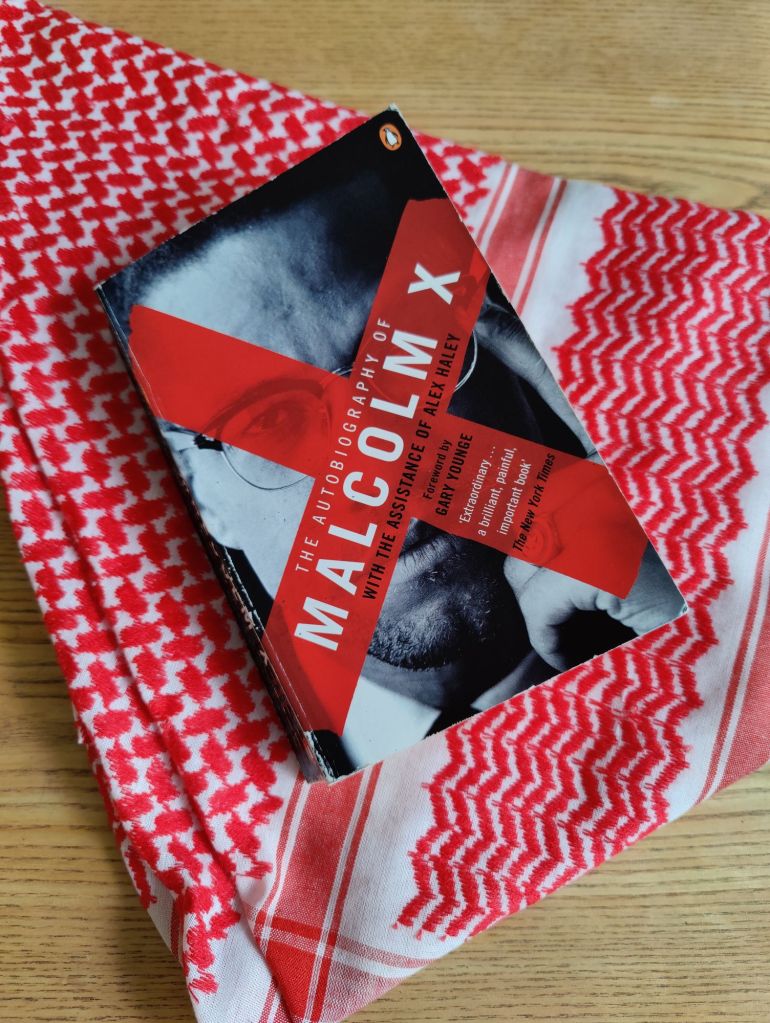
Back in America, Malcolm was greeted by a hostile press. Although his populism continued to rise his philosophies had changed. He wrote to his friends: “I’ve had enough of someone else’s propaganda. I’m for truth, no matter who tells it. I’m for justice, no matter who it is for or against. I’m a human being first a foremost, and as such I’m for whoever and whatever benefits humanity as a whole.” While the American media conglomerates used him as a scapegoat, he would use every TV, Radio and print interview to highlight the wanton discrimination and hypocrisy in American society. The last chapter of the book reads like an emergency call to action, that is still, unfortunately relevant today. His pleas to his audiences become more urgent, asking them to recognise that a system built on violence, exploitation and white supremacy can’t now blame the victims, when the seeds it has planted begin to bloom. Malcolm systematically lays out the foundations of the arguments we hear so frequently today. He reminds white America that when it came to these shores, it certainly didn’t come peacefully. How white society hates to hear of its crimes against black people and that peaceful coexistence has never been on its agenda, why should it be on that of those it has oppressed.
It would be amiss for me to not mention something about Malcolm’s attitudes towards women, as there are passages in this book that make for uncomfortable reading. I don’t for a moment think that Malcolm was a misogynist, as a few have claimed. Neither do I think its helpful to apply our sensitivities today to the life of someone born a hundred years ago. America, in 1925 was a deeply divided, racist and patriarchal society. White women in America were only give the right to vote in 1920, when the nineteenth amendment was ratified, but most black women, had to wait another five decades before they could exercise the same rights. Divorce instigated by the women didn’t become legal until 1937, violence against women wasn’t officially recognised until 1994. Although some white women had property rights by 1940, most other women, including some white unmarried women didn’t. Of course they had limited employment opportunities and there was no such thing as equal pay. To suggest these societal attitudes didn’t have an impact on Malcolm would be absurd. Malcolm witnessed domestic violence as a child, he was taken away from his mother during his formative years, and as a teenager lived in a house with prostitutes. He experienced extreme poverty and saw people at their lowest points trying to make ends meet, by any means necessary. He saw people as they were and spoke his truth, from his experience, with a candid and blunt delivery, which can make for some tense and awkward reading. Yet at the same time his greatest support, financial, emotional and educational, came from his sister Ella and his wife Betty, both of whom he speaks about with great love and admiration. He was a product of his time, even though he was a brilliant, wise, revolutionary, he was still a man, and as such prone to failings but always looking to improve himself.
I hope these four thousand plus words convince you to pick up a copy of this amazing autobiography. It is a text that meets you where you need to be met. If you’re simply curious, enjoy its beautiful writing and storytelling, if you like history and religion, revel in its reports and utterances. If you want to learn about people and society, this is a cultural and psychological anthropology. I’ve come to appreciate that things come to you exactly at the right time in your life. Malcolm X’s autobiography came to me just when I needed it. I hope this remarkable book makes its way to you soon.
 This Hybrid Reads