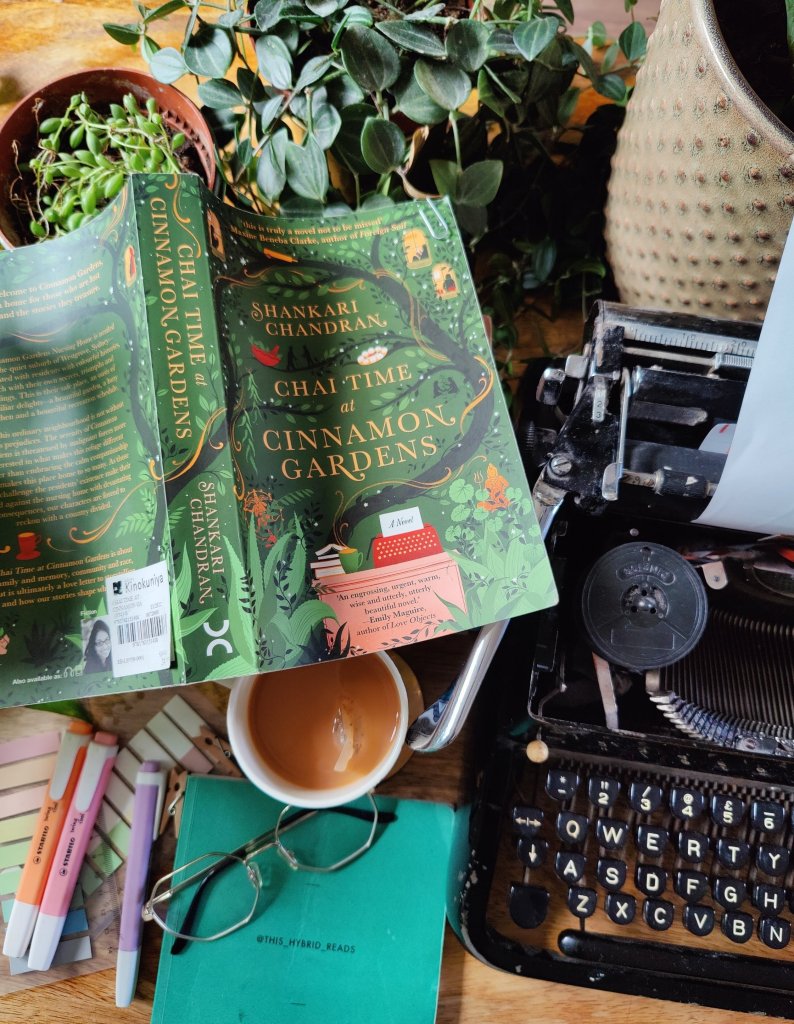
Chai Time at Cinnamon Gardens by Shankari Chandran is a multi-generational tale told from the perspective of five interconnected characters, each suffering their own silent traumas. The story is set between Sri Lanka and Sydney, Australia from 1977 to the present day. Maya, her husband Zakhir and their three year old twins Anjali and Siddharth arrive to the nursing home, at the invitation of an old friend Cedric. We learn later in the book that they are escaping the increasing violent persecution of Tamils by the Sinhalese dominated government. They arrive in an Australia where racism is entrenched in every aspect of society. The exclusively white staff and residents begin to flee from the home and over the years, are replaced by a more diverse but predominantly Hindu Sri Lankan resident base. With each changing perspective we get a richer understanding of life in both countries, as well as each characters personal journey.
The five protagonists are: Maya, the matriarch, her daughter Anjali, who is Doctor but now manages the Nursing Home in her mothers stead. She is married to Nathen and they have three children. Ruben is another character from Sri Lanka, he is clearly highly educated, and speaks 10 languages, but in the nursing home he is akin to a general caretaker, and works closely with Maya. Nikki, who is Anjali’s best friend, also works in the nursing home as a doctor. She is married to the final protagonist, Gareth, who works in the local council and is stepping in as acing mayor for the community, after a scandal with the previous mayor saw him stepping down. Nikki and Gareth have a son. They are also mourning the loss of their daughter from a tragic accident 10 months earlier.
Let me start by saying I really, really enjoyed this book. It’s not something you can sit on your sofa and read in 24 hours, the writing demands that you read every word. It’s not just beautiful, but it’s thoughtful. There are huge chunks of the book that I wanted to highlight and draw hearts besides, because Shankari Chandran writes evocative and considered prose that you want to keep returning to. And yet there were a few things that didn’t work for me.
The book tackles many issues, from child loss, relationship breakdowns, abandonment, to civil war, racism and settler colonialism. It also highlights what it means and how hard immigrants work to fit in and be perceived as ‘good’. The multiple perspectives and setting the story over a number of decades shows how people are not a product of a single moment. Although the story has five main protagonists, there are many, many more characters and some of them felt too saccharine to me, to convenient and a little too on the nose in certain parts. Although I appreciate what the author is saying by making them so perfect: that even when we are the good immigrants, drs, married to white spouse, running a successful business, it’s often still not enough to save us from racists and racially motivated attacks.
As soon as Maya and her family take over the running of the nursing home they face micro aggressions and racism. The flashbacks highlight hostility and suspicion from organisations, whilst in the present Ruben is attacked by a gang of white boys on his way to work and racist graffiti is sprayed onto the sides of the building. These attacks are brushed under the proverbial carpet by both the police and local council. It’s initially Gareth, at Nikki’s bequest, who raises these concerns but on a visit to the nursing home he spots an abandoned, toppled statue of Captain Cook, and when he learns that Anjali’s father took the statue down, he sets off a series of events that lead to the nursing home becoming the centre of a national race scandal.
Shankari Chandran explores Australia’s racial tensions in a really clever and interesting way. By juxtaposing them with the ethic tensions in Sri Lanka, also carefully crafted by its colonial overlords, the British (the familiar strategy of divide and rule was implemented to exacerbate differences between the Sinhalese majority and Tamil minority), she highlights the deeply human need to belong. The white Australians who are so afraid of their land being overtaken by non-white immigrants, refuse to acknowledge that the land was never theirs to claim. As the situation escalates, and politicians from the far right become involved, it becomes clear that Gareth is just a pawn in a greater and much deeper national wound that is far from healed. When the Donald Trump-esque politician Senator Graham accuses the nursing home of being run by Muslims (because Muslims are the real boogiemen) the violence and hatred escalates. Shankari incorporates tweets into the text to share the feelings of the general population and highlight how social media makes keyboard warriors of us all.
This is not a book about Muslims but it does highlight how in the last few decades Muslims have been so maligned that just using the M word gets an instant, vitriolic, reaction from some parts of the media and fake news and misinformation spreads like wildfire. The racists in this book don’t disappoint. A Muslim author is called onto a local TV station to answer for those in the nursing home and we are introduced to Tanuza Rahman, a bestselling Bengali author. I have to say I was a little taken aback by her description in the book. First her balayaged hair is mentioned, then her style of make-up “beauty enhancing but nor intellect undermining”, whatever that means, and finally “the whole look said ‘Earnest and Sophisticated Muslim’ not ‘Angry and Dangerous Muslim’. I’m still sitting with this passage and no matter how many times I read it, I find it uncomfortable. I’m unsure if this was meant as a tongue in cheek comment, but the implications are clear – Muslim women have to look a particular way for them to be perceived as ‘good Muslims’.
I enjoyed reading Maya’s exploits with the publishing industry. Her initial rejections were based not on her writing but on her otherness that (white) Australians were not ready for. When she decides to write under a pseudonym she is instantly picked up, becomes a best seller and household name. When Twitter becomes the inevitable battle ground and courtroom, it’s Maya’s tweets that win the hearts and minds of white suburban Australia! For me, this was just too convenient and neat, it lacked the authenticity of real life. No one, even our most beloved authors are safe in the Twittersphere. I do appreciate what Shankari Chandran was trying to do here, but it felt a little too forced.
Although the book deals with a lot of heavy topics, there are bits within it that will make you laugh or at least roll your eyes. Cultural appropriation makes a few appearances and as a South Asian reader I was Anjali in each of those moments. Mel, a white yoga instructor offers her services at the nursing home, which Anjali politely declines as they already have a very popular class run by 72 year old Aunty Yagnik. Mel, unwilling or unable to take the hint says “I’m looking for people who might benefit from the ancient wisdom I’ve learnt” the lack of awareness of these words made me snort into my chai. #weseeyou
The author has clearly spent a long time researching this book, and her passion comes through on every page. My favourite lines and words of wisdom were often from Maya’s father. I loved the exchange between the two discussing the continued role of the British Council in its ex-colonies. “The programme ensures that illiteracy is not a barrier to economic colonisation. It’s been thirty years since India and Sri Lankas independence from those marauding imperialists. The British Council is funding English literacy in the colonies so it can plunder our workforce to enrich its economy” Where are the lies? Another exchange between the two I enjoyed was during their discussion about Maya and Zakhir’s controversial marriage (Maya is Hindu and Zakhir Muslim) and them potentially being alienated, her father says ” We were not meant to live like this, we have been joined to our families, our people and our homeland for a reason” which is the poignant sentiment at the heart of this book. I enjoyed these exchanges so much so I can almost overlook the “Rumi was an Idiot” comment. Almost! Finally the other quote I really liked in this book, which also ties into its themes is “Possession of land is nine-tenth of the law. Possession of history is nine-tenth of the future”
Overall I really enjoyed my time with this book. I’m not one to read synopsis, so I didn’t have any idea what to expect from the story. The title certainly doesn’t give any clues. It is a gripping and engrossing exploration of trauma, of family and of the consequences of mis-told histories. Nothing lures me into a book more than the words on the pages, and Shankari is an artist who know exactly how to use her tools. The storytelling is impeccable.
Chai Time at Cinnamon Garden is written by Shankari Chandran and was published by Ultimo Press in 2022.
Shankari Chandran won the 2023 Miles Franklin award for Chai Time at Cinnamon Gardens
 This Hybrid Reads