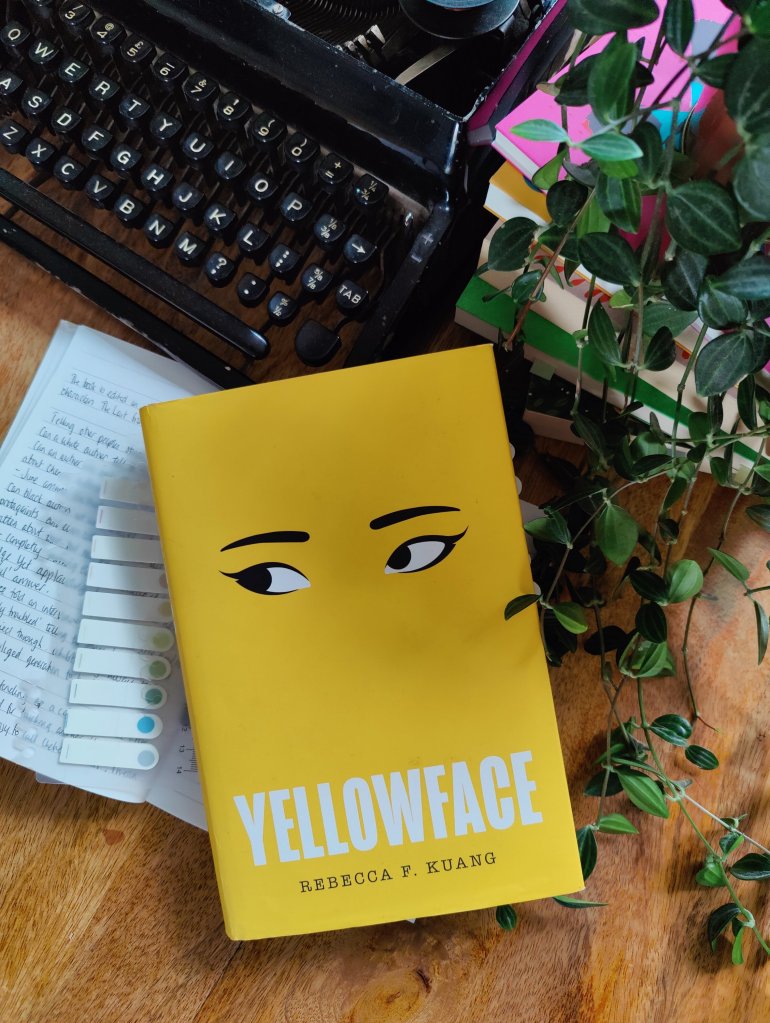
Yellowface is the story of two fast friends, Athena Liu and June Hayward who initially bonded over their mutual love of Elif Batuman‘s The Idiot whilst studying at Yale. Both dreamed of becoming writers with Athena going on to have a very successful career even before graduating. We meet the two while out celebrating Athena’s TV deal with Netflix’s and learn of June’s misfortunes in publishing in stark contrast to her friends rapid rise. We learn that June doesn’t really like Athena and harbours a intense jealousy. As the night goes on, they continue their celebrations in Athena’s lavish and expensive apartment. Things take a weird turn when Athena dies choking to death on a pancake and June steals her unpublished manuscript and ends up publishing it under the ambiguous name Juniper Song.
The opening chapter sets you up for the fast pace of the book. June, who narrates the story, is awful. Her capacity for self pity and to centre herself in everything is astonishing. She is completely without compassion, and this is highlighted by her lack of relationships, even (or maybe especially due to) with her own family, who are also terrible! The text is Junes stream on consciousness, and some of it is truly appalling. After stealing Athena’s work she justifies it to herself as “And fuck it, I’ll say it: taking Athena’s manuscript felt like reparations, payback for the things that Athena took from me”
When June/Junipers stolen script is sent out to publishers, she finds herself in the frenzy of a publishing world unfamiliar to her. The ‘The Last Front’ is put to auction and has a lot of interest. The novel is about the unsung contributions and experiences of the Chinese Labour Corps, the 14,000 Chinese workers who were recruited by the British and sent to the Allied Front during World War 1. She is assigned a new editor, an even more awful character than June, Daniella Woodhouse. Together they work on the text and “soften” the language as well as the white characters. June’s internal monologue during this process accuses Athena of having a bias and creating “cartoonishly racist” British and French solders, all whilst acknowledging the depth of research her deceased friend put into this project. The two women edit the text to make it more palatable to “readers” re: white people.
I absolutely loved all the social commentary on the publishing industry, which we know continues to be disproportionately white. As an avid reader, reviewer, and advocate for diversity in publishing, I could hear the words of many non-white authors ringing in my ears as I read these passages. The demands to have white characters, to not use own languages or to have it translated (something that isn’t required of European languages) and the “softening” of themes so as not to offend white sensibilities. As a sidenote, it was super interesting to me to read some of the reviews of Yellowface by Caucasian reviewers, who clearly failed to see the subversive nature of the book.
I think Yellowface is more about an overall message than a neat and tidy thriller plot. There are more than a few convenient passages in the book, but these don’t take anything away from the overall story. The writing is both sharp and funny and the pace is fast moving, so much so you don’t want to put to put it down. In fact I can’t remember the last time I devoured a book the way I did this one.
When ‘The Last Front’ is finally published it is, as expected, a huge success. At this point the story shifts from being less about the publishing process and more about readers and reviewers. Rebecca Kuang turns her attention to social media! Again there was so much I enjoyed in this part of the book, not least because it held up a mirror to my own behaviour. Fact checking and verifying information before sharing and liking is not a major concern on apps that require nano seconds of our attention. Cancel culture and the darker side of the web are all explored, and momentarily the readers sympathy shifts slightly in Junes favour, but not for too long because just as you begin to think June couldn’t sink any lower, she does.
There are interesting points within the book about telling other people’s stories, and Juniper is called out about this at her book signings. Unable to take criticism, and unwilling to accept that not all stories are hers to tell and profit from, she refutes these with carefully practised answers that she applauds herself for, but we can see, as readers, are examples of her white privilege. As the story continues to spiral into chaos, and Juniper is accused of plagiarism and cultural appropriation, the author very cleverly segways into telling us about her childhood and her family. At a barbeque, her sister Rory is defending a colleague after she is reprimanded for touching another persons hairs. Her defence “It’s crazy to call Chelsea a racist, I mean she’s a Democrat – She voted for Obama” You begin to see the environment that formed June into being who she is.
Things begin to get fantastical towards the end, but none the less completely compelling. Yellowface took me through a spectrum of emotions: anger, shock, joy, surprise, amusement, horror, excitement and ultimately satisfaction. I love fiction with social commentary and this one is packed with a cast of unlikable characters who are also on some level relatable. For me, the biggest baddie in the book is Capitalism and the race to the top it forces us all on at the expense of everything else. The desire to “make it” at any cost. The book uses extreme examples, but we can all relate to the envy of looking at someone’s seemingly perfect life and wishing that it was ours.

