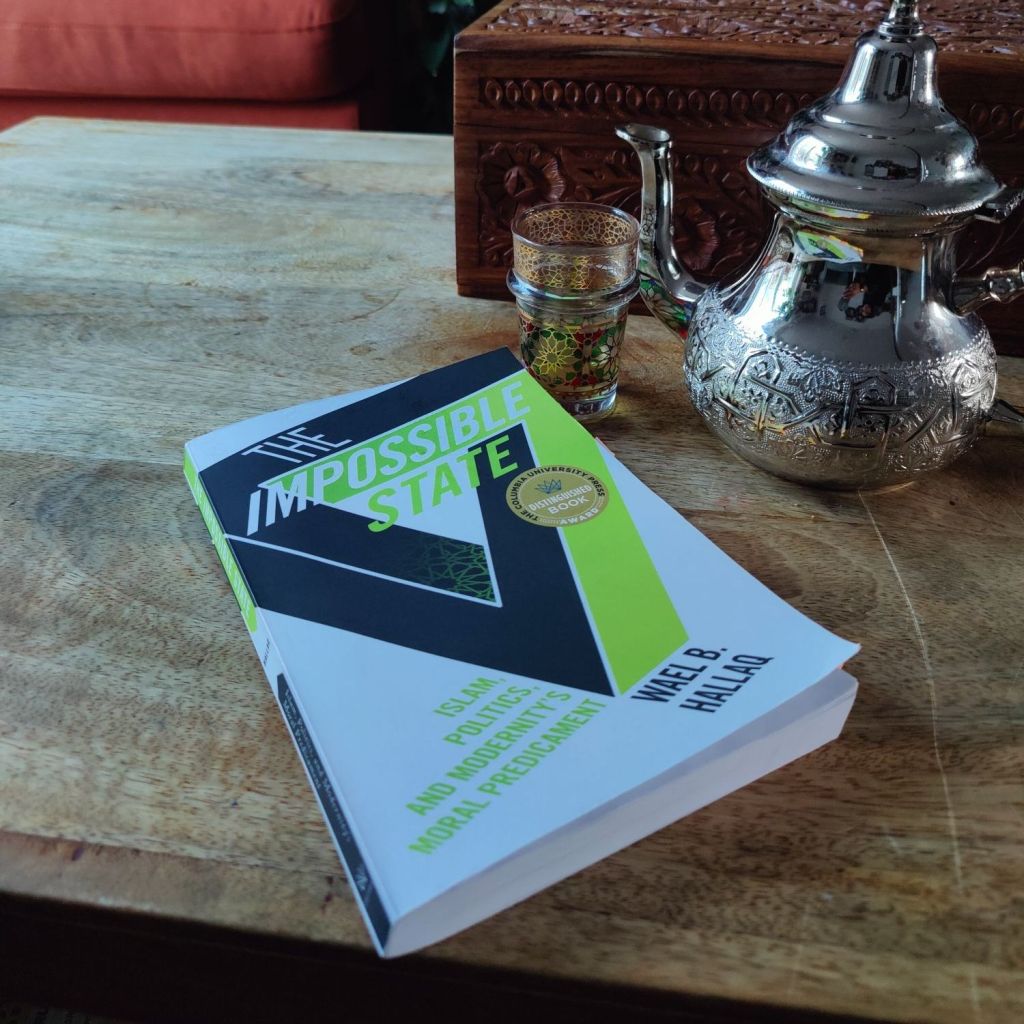
I stumbled upon The Impossible State while on my way to reading Restating Orientalism. In its introduction, Wael B. Hallaq urges readers to engage with his earlier work to better understand his broader arguments. Since I already owned a copy, I reluctantly set Restating Orientalism aside and began working through The Impossible State instead. Hallaq, the Avalon Foundation Professor in the Humanities at Columbia University, is widely regarded as one of the leading scholars of Islamic law. A Palestinian-American Christian, his work sits at the intersection of ethics, law, and political theory. I first became aware of his writing after reading Orientalism by Edward Said, where many pointed toward Restating Orientalism as a more contemporary and nuanced extension of Said’s critique. While I found myself largely persuaded by Hallaq’s arguments, The Impossible State is undeniably a dense and scholarly read. Its language assumes some familiarity with political theory, and it takes time to fully settle into its rhythm. That said, the intellectual payoff is significant.
The crux of Hallaq’s argument is that the modern nation state is incompatible with the sharia, also known as the Islamic State (no. not the IS that is probably funded and founded by the CIA and finds itself spreading discord and terror is Muslim lands). In order to do this is defines modernity, morality and the nation state. He promulgates that the state is a modern creation and its morality is fluid, no longer defined by God or religion, but power: economic, judicial and violent. In order for a modern state to be defined as such he argues it must have five form-properties: (1) its constitution as a historic experience that is fairly specific and local; (2) its sovereignty and the metaphysics to which it has given rise; (3) its legislative monopoly and the related feature of monopoly over so-called legitimate violence; (4) its bureaucratic machinery; and (5) its cultural-hegemonic engagement in the social order, including its production of the national subject. Hallaq’s arguments are cogent, convincing and compelling. He sets the scene for each argument, its academic and comprehensive. Understanding the modern nation state is essential. This post enlightenment establishment was birthed from Western Europe and North America and due to colonialism, followed by the creeping insidious impact of capitalism, countries across the globe were carved up to suit the economic ambitions of the empires that had once dominated them. In contempory discourse, the nation state is a given, as if it’s the only possible outcome for communities to organise. What came before European enlightenment is seen as barbaric and pre-civilisation, to critique it is considered injudicious, for in modernity progress only has one projection. No lessons can be taken from the past and certainly not from cultures and traditions outside of Europe, at least not with any honesty.
Hallaq’s exploration of morality is compelling. When God and religion are removed from the equation, leaders from whatever denomination of political ideology, become the all-powerful. The judiciary, the military and the bureaucratic all become one. The book highlights the incongruence of democracy, especially in its current iteration, through exploring education, health care, climate change (and catastrophe) and the increasing wealth gap between so-called equal citizens. The system was set up to favour some over others, and the modern citizen is designed to stay, for the most part, trapped in the machinery of capitalist exploitation, so much so that they are unable to fully participate. This book was published in 2013, and I can imagine people refuting its claims back then, but reading it in 2026, and witnessing the redundancy of organisations such as the United Nations, it’s hard not to agree with almost everything Hallaq presents. As an educator, his analysis of the education system, designed to incarcerate rather than liberate minds, is particularly thought-provoking. Legislating mandatory education, coercing parents to send their children to schools where certain ideas and ideals are drilled into them, so that parents can work and feed the insatiable appetite of the Capitalist machine, and prepare young minds to also fall into their role of “workers” and therefore a “responsible citizen”. When Hallaq speaks about the emotional impoverishment of the modern citizen/subject, having fallen prey to a “culture industry” leaving them isolated and fragmented, one can’t help but take a moment of reflection. And of course, the demise of community and family, only leaves us more isolated and fractured. Hallaq juxtaposes this with an Islamic system, which irrespective of being led by a Sultan, or Amir, still has God as its moral guide thus forcing a moral separation in society. The leader of such a state, however powerful, was also answerable to God, and therefore the Sharia was applied to them too, not simply imposed by them onto subjects. In fact, Hallaq speaks to the complicated system of governance that included a true separation of legislature, the executive and the judiciary, something that just isn’t viable in the modern nation state.
In just 170 pages Professor Hallaq lays out the most comprehensive argument for Islamic governance I have ever read. Unfortunately, as he predicts, the modern nation state and the Islamic world as it is today, is unable to truly represent the values and morals of an Islamic State. It is an absolutely fascinating and compelling argument, and leaves the reader with a much richer understanding, of both the nation state as it currently is and also of what an Islamic state would have looked like in the past, without the maligned and obscured lens of anti-Islamic rhetoric that often hijacks the conversation. This is an important book for anyone curious about Islamic Law and the “creeping sharia” myth that is often peddled by Islamophobes. The legal system already has Islamic principles, and much of European “enlightenment” is based on ideals appropriated from science, art, and traditions from the global south. History didn’t begin with the Enlightenment as much as western philosophers try and convince us otherwise. Colonialism didn’t just pillage and murder its way across the globe, it cut short systems and societies that had flourished for centuries. And as we continue to see from tribal societies in places like Afghanistan, Iraq, Kenya and Tanzania, communities organise themselves in ways that suit their traditions, and that doesn’t necessarily complement the modern nation state model, nor does it mean those societies are “failures” just because they don’t adhere to a one (Western) size fits all model.


Very interesting analysis! Do you have any other recommendations for books on Islamic governance, and Related topics?
LikeLiked by 1 person
Hello, I think Hallaq’s other book, Restating Orientalism, is also about Islamic governance, but I have yet to read it. I would recommend the YouTube channel Blogging Theology as he does lots of reviews on books on Islamic history and governance. He has a conversation with Imam Tom about this book which is very good. I hope that’s helpful. Mina
LikeLiked by 1 person