When I bought my 2026 diary and calendar, I rushed to fill it with all the important dates: birthdays, anniversaries, Eid, Ramadan, especially the last 10 and Dhul Hijjah, the best 10 days of the year. I made my intention to fast on the day of Arafat, and let everyone know that I would be out of action during these sacred days. Even my google calendar had the a bright red banner warning everyone I was “busy”. And then, on the day before Dhul Hijjah, an uninvited guest arrived. My period. As we say in Muslim circles: “we plan, and Allah plans, and Allah’s plan’s are the best of plans”.
The importance of worship cannot be understated in Islam, intentions and actions are integral to our practice. The five daily prayed are central to our faith, with the Hanbali School going so far as to argue that those who abandon prayer abandon faith. (The Hanafi, Maliki, and Shafi’i schools consider it a grave sin, but don’t think it takes a person outside the folds of faith). Typically, just before Ramadan begins, mosques and online sermons inundate us with important acts of worship and how to best use our time in that sacred month. The same is true for Dhul Hijjah, which begins with the best 10 days of the year. It is the only time of year that all 5 pillars of faith are integrated in worship, as it culminates with the annual Hajj pilgrimage. We are encouraged to fast, to increase in our prayers, and to read and complete the Quran and much as we can. Ad yet all these acts of worship require ritual purity and therefore are not permissible to women during their period or the 40 days after giving birth.
It’s pretty safe to assume that women make up 50% of the Muslim population, and whilst our periods are not all synced, a large number of us, including myself won’t be able to participate in the acts of worship for Dhul Hijjah as we had planned. For years this used to upset me. Why was I being denied the opportunity to participate and generate the most rewards possible. Was Allah, the Most Merciful and the Most Compassionate, closing these doors of worship because I didn’t deserve the abundance of reward on offer? Of course not. The same Lord who decreed these sacred months and these acts of worship, also decreed the rest that my body was now commanding of me. It may be a surprise to me, but it was always a part of Allah’s divine plan and wisdom.
Worship can take many forms, and while I will miss connecting with my Quran in Arabic and standing and prostrating on my prayer mat, I also know that Allah (swt), Al-Fattah (the Opener) and Al-Kareem (the Most Generous) has decreed this pause in worship for me to grant me blessings and rewards from other sources. He (swt) is Al-Lateef (The Subtle) and Al-Rauf (The Most Kind), it’s for me to make the most of these days by doing what I can.
Before I detail what I will be doing in these sacred days, I want to share with you the poignant imagery of Hajar (as) alone in the burning heat of the Arabian dessert, with her baby boy, Ismail (as). According to the Bible (Genesis), Ismail (as) was a young man between the ages of 14 to 17, when him and Hagar were sent away. This is markedly different to the Islamic understanding, where Ismail (as) is described according to Sahih al-Bukhari (Hadith 3364), as a suckling infant (baby) at the time. He was entirely depended upon her. She lay him down on the dessert sand as she desperately ran between the hills of Safa and Marwa, searching for water to save his life. She wasn’t in a mosque, or standing on a prayer mat, yet her efforts have become part of the most sacred ritual of all, the Hajj. Not only do we trace her footsteps we also have the blessing of Zamzam, which was a divine response to the plight of a desperate mother. Zamzam continues to flow to this day, despite being located in an extremely arid desert and consumed by millions of pilgrims year-round for centuries.
Ways to Worship in Dhul Hijjah (without Salah or Fasting)
Getting your period during the best 10 days of the year doesn’t mean you’re exempt from the rewards, it simply means the way you worship changes. Below are a few of my favourite things to do to keep me spiritually nourished.
1. Keep Your Tongue Moist with the Dhul Hijjah Takbeeraat
Dhul Hijjah has a very specific Dhikr (remembrance of Allah). The Takbeerat act as a constant verbal reminder to stay focused on worship, gratitude, and good deeds during this high-reward window. Reciting these praises is a direct command from the Qur’an and a practice of the Prophet Muhammad ﷺ. The Qur’an instructs Muslims to “remember the name of Allah or mention Allah during well-known days” (Surah Al-Hajj, 22:28). Most scholars agree that this refers to the first 10 days of Dhul Hijjah.
اللهُ أَكْبَرُ، اللهُ أَكْبَرُ، اللهُ أَكْبَرُ، لَا إِلٰهَ إِلَّا اللهُ، وَاللهُ أَكْبَرُ، اللهُ أَكْبَرُ، وَلِلهِ الْـحَمْدُ
Transliteration: Allahu akbar, Allahu akbar, Allahu akbar, la ilaha illa-Allah, wa Allahu akbar, Allahu akbar, wa Lillah il-hamd.
Translation: Allah is the Greatest, Allah is the Greatest, Allah is the Greatest, there is no god but Allah. Allah is the Greatest, Allah is the Greatest, and to Allah belongs all praise.
Any and all dhikr is valid, and can be done at anytime during the day and night. If you can’t pray, you can still wake up in the pre-dawn hours to do some remembrance, or even with its salah time to keep you in the prayer-time habit.
2. Read the Quran in Translation
One of my absolutely favourite things to do is to read the Quran in translation. Yes, the rewards for reading the Quran in Arabic are by far the highest and so much is lost in translation, but being able to understand the stories and the lessons of the Quran, elevate the experience, especially to those of us who don’t know Arabic . You can read it from cover to cover in your language, or you can do a deep dive into your favourite surah (chapter). Spend time with each verse and contemplate the meaning, and how it impacts you. The Quran is healing, it is light and it is guidance. Allow yourself the blessings of the Quran, whatever time of the month it is. Carve out some time in your daily schedule to sit with the Quran, whether its 5 minutes or 5 hours, do what you can, but make it part of your every day.
A few of my favourite translatiosn are:
“The Qur’an” by M.A.S. Abdel Haleem (Oxford World’s Classics): Known for its highly readable, accurate, and flowing modern English prose.
“Saheeh International”: A widely used, straightforward translation that closely follows traditional interpretations.
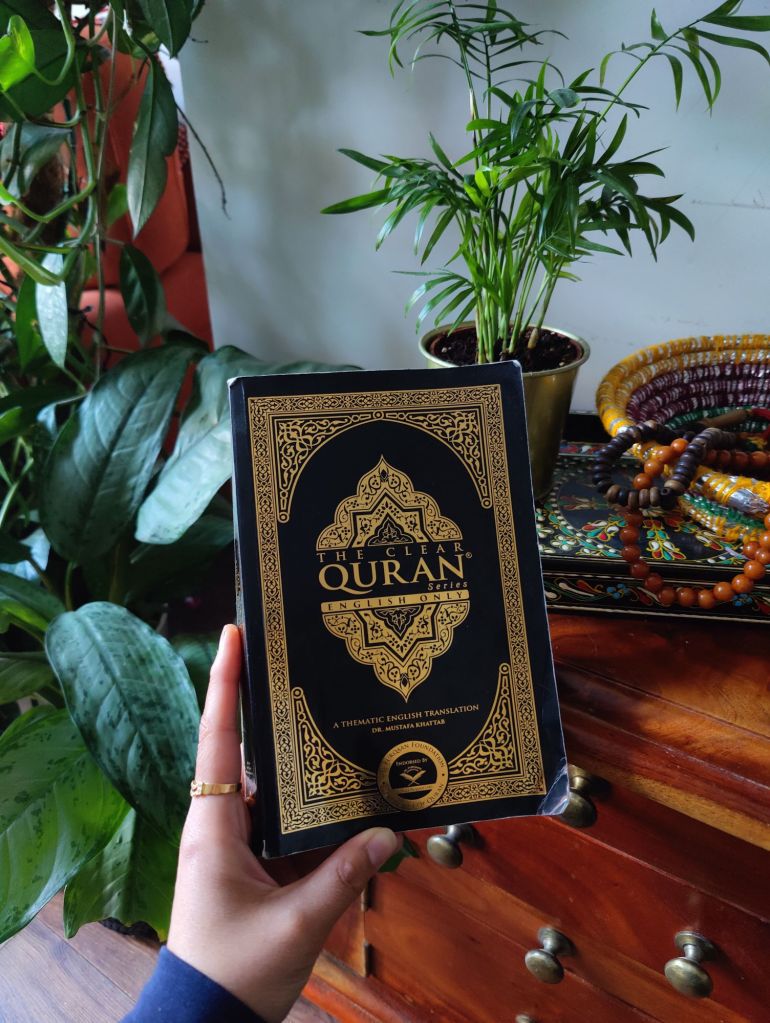
The Clear Quran by Dr. Mustafa Khattab: Masterfully groups verses by theme and uses highly accessible, everyday English. It is widely endorsed by global Islamic councils.
3. Listen to the Quran
It sounds like a no-brainer, but it is actually one of the things that I find people neglect. The Quran should never be back ground noise. These are sacred words and deserve your full attention. I personally can’t listen to the Quran while I’m cleaning, cooking or evening ironing, I get distracted. When I listen to the Quran I like to listen to the surah’s I know, so I can recite along with it, or I will listen when I’m doing absolutely nothing, so I can give it my full attention. Sometimes I like to read the English whilst listening to the Arabic. I find listening to the Quran soothing and relaxing, and it’s something I lean heavily on, especially on days that I feel anxious and stressed.
Some of my favourite reciters are:
Sheikh Noreen Muhammad Siddiqui
The more you listen, the more you’ll find a reciter that you really love. I’m always looking for recommendations, so do let me know who your favourites are.
4. Give Charity
Islamically, charity takes many forms. You can donate money to charity, your local mosque, or to a foodbank. Alternatively you can find ways of helping and serving people. The Prophet Muhammed ﷺ said: “Your smile for your brother is a charity. Your removal of stones, thorns or bones from the paths of people is a charity. Your guidance of a person in a place where there is no guidance is a charity.” (Al-Tirmidhi). Acts of kindness, sharing knowledge and even caring for your family all serve as charitable acts and are all heavy on the scales.
Below are a few of my favourite hadiths on charity:
Prophet Muhammad (SAW) said:
“Give charity without delay, for it stands in the way of calamity.”
“Allah said: ‘Spend, O son of Adam, and I shall spend on you.'” (Sahih Al-Bukhari)
“Never does a Muslim plant a tree or cultivate land, and a bird, a man, or a beast eats from it, but that it is a charity on his behalf.” (Sahih Muslim)
“Charity extinguishes sin as water extinguishes fire.” (Jami` at-Tirmidhi)
“The believer’s shade on the Day of Resurrection will be his charity.” (Musnad Ahmad)
“When a man dies, his deeds come to an end except for three: an ongoing charity (Sadaqah Jariyah), knowledge from which benefit is gained, or a righteous child who prays for him.” (Sahih Muslim)
“Charity given to the poor is a charity, and that given to a relative is two things: charity and upholding family ties.” (Sunan an-Nasa’i)
5. Feed the Fasting
The Day of Arafah (the 9th) is the pinnacle of Dhul Hijjah. While you cannot fast yourself, you can inherit the rewards of those who do. The Prophet ﷺ said: “whoever feeds the fasting person gets a reward equal to theirs, without decreasing the fasting persons reward”.
You can prepare Iftar for your family, pay for a fasting persons meal, invite friends over for Iftar, or donate to a charity that feeds the poor on this day.
Remember, Your Biology is Not a Barrier
If there is one thing you take away from this Dhul Hijjah, let it be this: your cycle is not a spiritual failure. It is a divine design.
When you sit out from prayer or fasting because of your period, you are not being disqualified from the race. You are actually obeying the exact same Lord who commanded you to pray in the first place. In Islam, submitting to Allah’s command to rest is just as much an act of worship as submitting to His command to prostrate.
Your Lord is Ash-Shakur (The Most Appreciative). He sees the longing in your heart. He sees the heavy sigh you let out when you realized you couldn’t fast on the Day of Arafah. He knows you would have stood in Tahajjud if you were able. Because of your sincere intention (niyyah), Islamic tradition teaches that your pen keeps writing, and your rewards keep piling up as if you had actually done those deeds.
So, roll up your prayer mat, but do not close your heart. Walk through the alternative gates of worship Allah has opened specifically for you this week. Pour your heart out in Du’a, let your tongue taste the sweetness of Dhikr, and find comfort in knowing that you are exactly where Allah wants you to be. You are not forgotten; you are simply worshipping in a different way.

