Women in Translation month is important for a multitude of reasons. Being able to access stories from other cultures and traditions allows us to connect with people and learn about the diversity of the world and increase our sympathies and compassion for people who we might not otherwise encounter expect through political narratives. It also accentuates shared human experiences. The themes of all of our stories are essentially the same: love, family, power, justice, betrayal or coming of age. Our context and customs add the flavours. For centuries women’s voices have been lost and suppressed in the world of literature, which even today continues to be elitist and predominantly white. That means the voices of the global majority have to be fought to be heard and its the women who have to fight he hardest.
The publishing industry has had a male bias since its conception. Although today the majority of the people working in publishing are white and female, data from the New York Times archives makes interesting reading. From 1950 to 2010 men dominated the bestseller lists and it’s only in the last decade that we have really seen an increase of female authors, albeit predominantly white. Todays bestseller list is a great example of this. Although the UK and America now have more females than male writers, only approximately 15% of all authors are people of colour. Let’s assume half of those are female (it’s difficult to get exact figures) that relegates the stories of women of colour to 7%. I won’t get started on the pay disparity, but these barriers are even greater for women who don’t write in English.
Think about the stories you grew up with, Aesop’s fables, Anansi, the fairy tales of Hans Christian Anderson? Or Aladdin, which is said to have its roots in Syrian storytelling. Or maybe you read Mrs Pepperpot or The Little Prince, all of these stories have been translated into English. Due to colonialism, stories were also stolen and told in the colonisers language. Stories such as 1001 Arabian Nights are often credited to French author Antoine Galland. Of course the other glaringly obvious fact is that they are all male! Women in Translation Month is important because it allows us to claim back some of what was stolen and to centre women in these stories, because lets be honest, behind every great male writer in our history, there is a female “muse”. Women were forced to write under male pseudonym to be taken seriously. We have been deprived of a wealth of literature and finally we can start o reclaim some of that.
If you were fortunate enough to grow up in a dual language home where you heard and read stories in multiple languages, you probably felt the power of language long before you knew what it was. I grew up on Urdu stories alongside English and the contrast in how language was used in both has always stayed with me. My love of poetry is definitely a homage to my mothers stories, her vivid and beautiful descriptions in Urdu, were in stark contrast to the blunt force that was English in an East London home. Even when I didn’t understand it, I felt the romanticism and softness of the language. People often quote French as the most beautiful language, but that instantly tells me that they have never heard anyone speak or read in Urdu, even translated you can feel its beauty and power.
Unfortunately it continues to be a struggle to get translated fiction in South Asian languages, although these countries have a rich history and tradition in literature and poetry. Tomb of Sand, written by Geetanjali Shree is the first book originally written in any Indian language to win the International Booker Prize. In a geographical area that makes up a quarter of the worlds total population, I find this astonishing. In fact less than 1% of translated literature in the US over the last 10 years is from South Asian languages. The lack of diversity in publishing has real consequences and this is just one example of that. In an attempt to tackle this diabolical lack of representation British writer and translator Daniel Hahn and the University of Chicago’s department of South Asian Languages and Civilisations professor and translator Jason Grunebaum have set up the The cross-continental South Asian Literature in Translation (Salt) project. It is a collaboration between the University of Chicago and partners include, American Literary Translators Association, English PEN, Words Without Borders and the British Council (the soft arm of the British foreign office – make of that what you will!)
If you are new to translated fiction then a good place to start is The International Booker Prize, The prize has been going since 2005 but it was only in 2015 when it became exclusively for translated fiction. I often find myself trawling its previous winners and nominations in search of translated texts. Unfortunately I don’t think many libraries in the UK have a translated fiction section and bookshops, if they have anything at all, tend to be mostly European, male and classics. It’s heartening to see books from East Asia break into the British market, but again, there is still a lot of work to do. Bookstagram is another asset and following hashtags such as #boksintranslation or #womenintranslation has always proved incredibly helpful to me.
What I’m reading for Women in Translation Month
It has been a struggle to put together this list as I have been unable to borrow or buy some of the books I’ve wanted to read. At this point it seems pertinent to mention that translated text, particularly the more obscure it is, tends to be more expensive than general fiction. My goal this year is to borrow rather than buy books and unfortunately my local library doesn’t have a great selection. I have put in a few reserves and orders but the library staff have more or less told me that they won’t be buying any of the texts. Two of the books I’ve picked have been gifted to me from the publishers, Charco Press, an independent publishing house aiming to bring readers the very best of contemporary Latin American Literature, translated into English. The other three are books that I have bought from second-hand bookshops based on recommendations. I have to confess that I have had these on my shelves for over a year. My hope is to read them before the clock strikes midnight on December 31st if not by the end of the month.
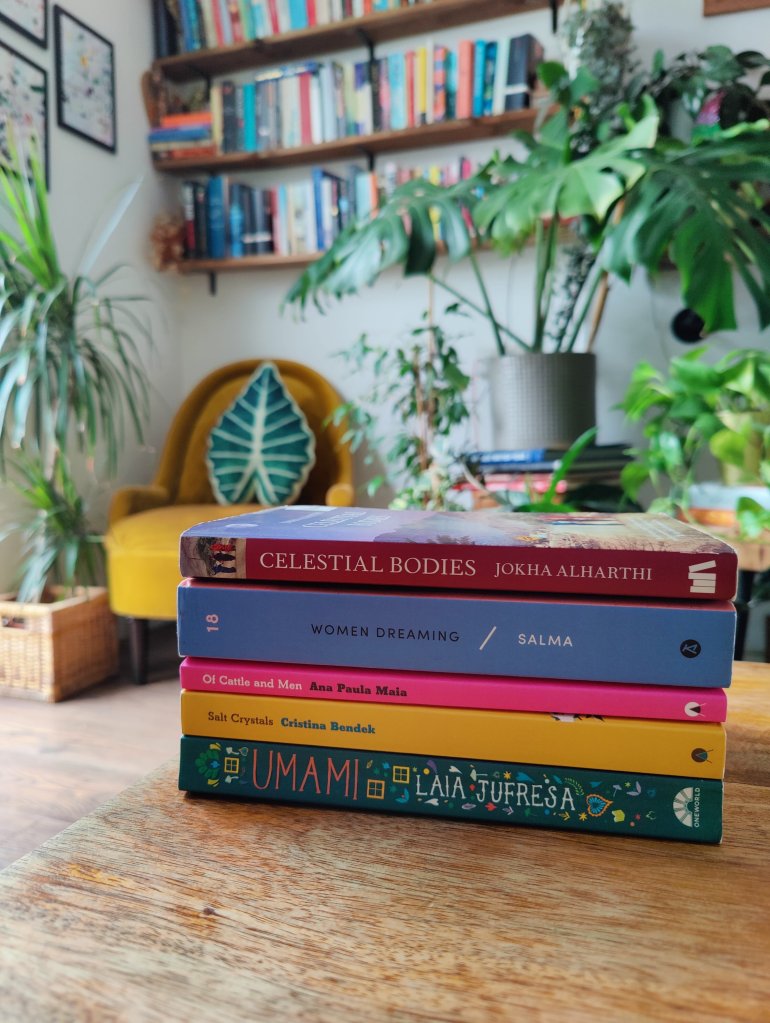
Below are the five books I’d like to read:
- Women Dreaming by Salma translated from Tamil by Meena Kandasamy – Longlisted for the 2022 Dublin Literary Award “What a life! She didn’t like being here, and she didn’t like going there.” Mehar dreams of freedom and a life with her children. Asiya dreams of her daughter’s happiness. Sajida dreams of becoming a doctor. Subaida dreams of the day when her family will become free of woes. Parveen dreams of a little independence, a little space for herself in the world. Mothers, daughters, aunts, sisters, neighbours… In this tiny Muslim village in Tamil Nadu, the lives of these women are sustained by the faith they have in themselves, in each other, and the everyday compromises they make. Salma’s storytelling – crystalline in its simplicity, patient in its unravelling – enters this interior world of women, held together by love, demarcated by religion, comforted by the courage in dreaming of better futures.
- Umami by Laia Jufresa translated from Spanish by Sophie Hughes (Set in Mexico City) – Deep in the heart of Mexico City, where five houses cluster around a sun-drenched courtyard, lives Ana, a precocious twelve-year-old still coming to terms with the mysterious death of her little sister years earlier. Over the rainy, smoggy summer she decides to plant a vegetable garden in the courtyard, and as she digs the ground and plants her seeds, her neighbours in turn delve into their past. As the ripple effects of grief, childlessness, illness and displacement saturate their stories, secrets seep out and questions emerge, and it becomes clear that Ana is not alone in having her world turned upside down by the loss of a loved one.
- Salt Crystals by Cristina Bendek translated from Spanish by Robin Myers (set in San Andres, Caribbean) – San Andrés rises gently from the Caribbean, part of Colombia but closer to Nicaragua, the largest island in an archipelago claimed by the Spanish, colonized by the Puritans, worked by slaves, and home to Arab traders, migrants from the mainland, and the descendents of everyone who came before. For Victoria – whose origins on the island go back generations, but whose identity is contested by her accent, her skin color, her years far away – the sun-burned tourists and sewage blooms, sudden storms, and ‘thinking rundowns’ where liberation is plotted and dinner served from a giant communal pot, bring her into vivid, intimate contact with the island she thought she knew, her own history, and the possibility for a real future for herself and San Andrés.
- Celestial Bodies by Jokha Alharthi translated from Omani Arabic by Marilyn Booth – Winner of The best Omani novel, 2010 and The Man Booker International Prize 2019. Celestial Bodies is set in the village of al-Awafi in Oman, where we encounter three sisters: Mayya, who marries Abdallah after a heartbreak; Asma, who marries from a sense of duty; and Khawla who rejects all offers while waiting for her beloved, who has emigrated to Canada. These three women and their families witness Oman evolve from a traditional, slave-owning society slowly redefining itself after the colonial era, to the crossroads of its complex present. Elegantly structured and taut, Celestial Bodies is a coiled spring of a novel, telling of Oman’s coming-of-age through the prism of one family’s losses and loves.
- Of Cattle and Men by Ana Paula Maia translated from Portuguese by Zoe Perry (Set in Brazil) – Animals go mad and men die (accidentally and not) at a slaughterhouse in an impoverished, isolated corner of Brazil. In a landscape worthy of Cormac McCarthy, the river runs septic with blood. Edgar Wilson makes the sign of the cross on the forehead of a cow, then stuns it with a mallet. He does this over and over again, as the stun operator at Senhor Milo’s slaughterhouse: reliable, responsible, quietly dispatching cows and following orders, wherever that may take him. It’s important to calm the cows, especially now that they seem so unsettled: they have begun to run in panic into walls and over cliffs. Bronco Gil, the foreman, thinks it’s a jaguar or a wild boar. Edgar Wilson has other suspicions. But what is certain is that there is something in this desolate corner of Brazil driving men, and animals, to murder and madness
I’d love to hear what you will be reading this August and if you have any recommendations for translated fiction. Do let me know in the comments below. I will be reviewing all the above books on my Instagram account but let me know if you’d like me to share them on here as well.
Happy reading.
 This Hybrid Reads
I’ve read The Easy Life In Kamusari which I really enjoyed but I totally agree, there is a lack of translated fiction from our own community. Not being able to read or write Urdu means I miss out on some excellent work.
LikeLiked by 1 person
That’s why it’s so important that these texts are translated, so many readers from around the world want to know more about the diverse range of South Asian experiences, the history, the culture, and South Asia has such a solid history of excellent storytelling, it’s a shame that we are being denied it.
LikeLike