I’ll be the first to admit that I know very little about global politics and even less about the politics of Muslim countries. The reasons for this are: a) I don’t necessarily trust Western sources on Muslim countries and b) I haven’t done the reading/work on countries other than Palestine and Pakistan. However, with the current genocide in Gaza and the continuing ethic cleansing of the Palestinians from their homeland, it has become imperative upon us all to learn a little more about the region and its internal and external politics. Below is a map, which incorrectly calls occupied Palestine “Israel” which unfortunately we will have to work with.
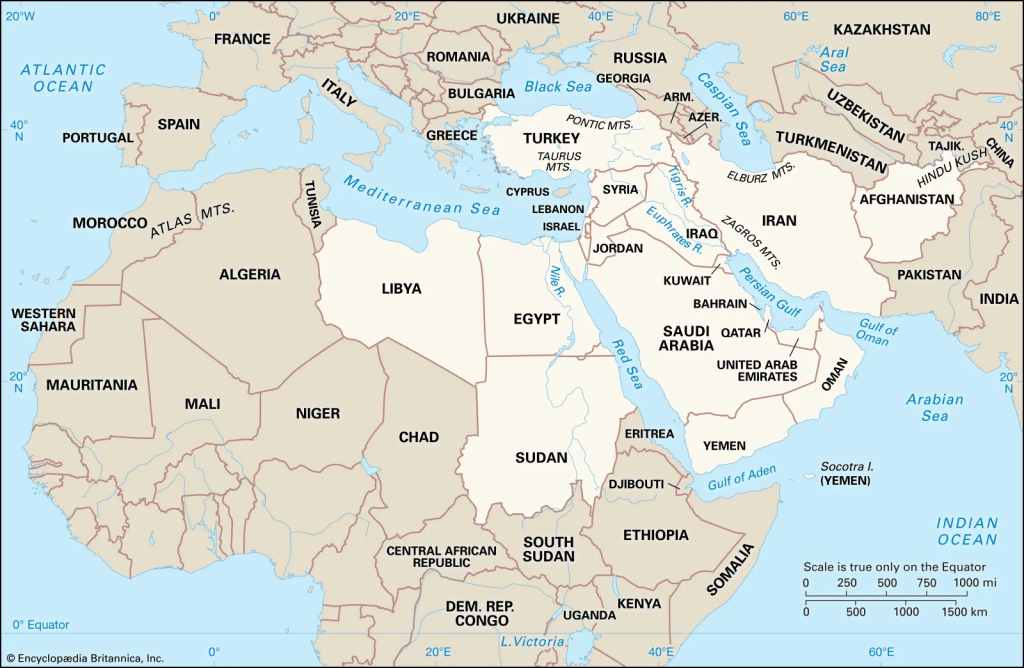
Straight away we can see the strategic importance of Palestine and why the British and their allies wanted to establish a base in the Middle East. As mush as the British like to portray their imperial past as a series of beneficent acts, they were in fact tactical moves to ensure their own dominance and control. Conservative, Arthur James Balfour was a determined imperialist. He supressed Irish independence, believed the Indians were incapable of self governing and in 1906 he declared “We have to face the facts. Men are not born equal, the white and black races are not born with equal capacities: they are born with different capacities which education cannot and will not change” regarding the morality of disenfranchisement of black south Africans. It is also argued that his antisemitism played a role in the Zionist project of creating Israel. He hoped that the declaration would rally American and German Jewish opinion to the Allied cause whilst simultaneously ending the flow of Eastern European Jews into Britain. The Balfour declaration was very much in line with previous British settler colonial projects, like those of Australia, New Zealand, Kenya and Rhodesia only this time the white Jewish settlers would take on the “civilising” mission. The rise of Hitler in Germany saw Britain and other European countries turning their backs on Jewish refugees, who were sent to, amongst other places, Palestine. Its important to remember that Churchill admired Hitler and devoted a chapter to him in his 1937 book on Great Contemporaries. In the same year, as a champion of settler colonialism, he stated “I do not admit…that a great wrong has been done to the Red Indians of America, or the black people of Australia…by the fact that a stronger race, a higher-grade race…has come in and taken their place.” What the current genocide in Gaza shows us is the importance of unpicking the narrative that we are constantly fed, through the political and media classes, and hopefully this will help us unravel the harmful lie that Israel is a legitimate government and understand the harm of settler colonialism.
Palestine is surrounded by Muslim countries and whilst some have spoken up against Israel’s genocidal campaign, many have remained silent and worse still have suppressed their populations from showing any support. Its generally accepted that a military solution is far to risky, for international players and global security, nobody wants World War 3, but many of these countries have other leverages, such as oil and gas, they can use to put political pressure on the Americans to get their wayward child, Israel, to back off. There are a number of reasons that this hasn’t happened. I’m going to focus on Saudi Arabia and Türkiye as I think they are the main players and they have been the main focus of the articles I have read.
Starting with Erdogan, who typically has very pro-Palestinian rhetoric. It was interesting then, when he came out after October 7th and gave an incredibly muted response to his people, presenting himself as a mediator rather than outrightly condemning the Israelis. Erdogan has for a while now been trying to normalise relations with Israel. At the last G20 summit The Middle East Corridor was announced. This is a trade route running from India, to the UAE, Saudi Arabia, Jordon, Israel and then into Europe. Take a look at the map above and you will see how this has the potential to revolutionise the economic landscape of these countries. It would also mean that Türkiye would no longer be the connection between Asia and Europe and push them out of a huge market. In 2019 Türkiye got involved in the civil uprising in Libya, recognising that it was becoming increasingly isolated in the region. Countries such as Egypt, Syria, Israel, Greece and Cyprus could potentially block its access to the Mediterranean, where gas has also been found, and exploration rights are being contested. Türkiye and Israel already have good trade relations and unlike other countries in the region also have direct flights connecting them. Erdogan, at the beginning of October was on the cusp of closer economic ties with Israel and didn’t want to risk harming that for the sake of the Palestinians. However as Israel’s genocidal campaign has continued, Turks have mobilised in their millions across the country to show their support for Palestine. The country is vibrating with anger and Erdogan has read the room correctly, and changed his stance to reflect the mood of the Turkish population.
In Saudi Arabia things are a little different. Firstly Saudi Arabia doesn’t have elections. The country is ruled by a hereditary king and therefore the people have no say in electing or changing its rulers. (It wont surprise anyone that the British were involved with the rise of this current dynasty when on September 23, 1932, Abd al Aziz ibn Abd ar-Rahman Al Saud established the Kingdom of Saudi Arabia, but that’s for another post!). In 2014, when oil prices collapsed, the Saudi treasury lost a huge amount of money due to the low oil prices. The then crown prince Muhammad bin Salman (MBS) recognised that they needed to diversify their economy in order to prevent a catastrophic crash in the future, and thus was born Vision 2030. MBS decided that Saudi needed to create cities that looked like Miami as part of their economic diversification. They wanted to revamp their global image, away from Islamic, to more modern and progressive. It opened its first bikini beach in Jeddah in 2019, a casino in 2020 and has been working hard to invite celebrities to host parties in the dessert. Bin Salman did a tour of America in 2018 meeting with big businesses including Mark Zuckerberg in order to sell Vision 2030. Unfortunately their attempts to modernise experienced a few road blocks, the most infamous being the murder of journalist Jamal Khashoggi in the Saudi consulate in Istanbul in 2018. When the reputational risks to investors seemed to be coming to an end, COVID hit and the whole world shut down. During this period they were also experiencing domestic issues, including attacks from Houthi rebels on their oil reserves. (Saudi had been at war with Yemen for 8 years which only concluded in March 2023). And then, at the tail end of 2020, when covid restrictions were finally lifting Saudi experienced another blow with the election of Joe Biden in America. Biden had been on record calling MBS a pariah and refused to deal with him. Then in 2021, Saudi decided, quite shrewdly, that anyone who doesn’t have head quarters in the Kingdom wouldn’t be awarded any of their lucrative government contracts. This is because companies wanted to trade with Saudi Arabia, but were setting up in neighbouring UAE, which has a much more acceptable public face.
In July 2022 Biden finally visited Jeddah, and what was supposed to be an amical meeting to relaunch Vision 2030 turned into even more of a clash between the two. Biden, with the camaras rolling, said he knew who killed the Washington Post Journalist, heavily implying he held MBS responsible! I’m not a fan of either men, but we know now that Biden has a propensity to lie in front of the camera. Bin Salman responded with asking the American President about his own human rights record, particularly concerning the murder of American Palestinian journalist Shireen Abu Akleh. (Shireen was an American citizen killed by the Israeli Occupation forces). Bin Salman went on to punish Biden further by cutting oil production during the American midterm elections and ramping up oil prices. This highlights that Saudi does have some economic power over America and is willing to use its leverage when its important enough. Apparently insulting Bin Salman is of more consequence than 6000 Palestinian lives. The Saudi rift with America made them see that the only other route they had into the American market was through Israel. In 2022 Saudi opened up its airspace to Israel. They also encouraged Bahrain to normalise relations with the occupiers. In November 2020 Netanyahu made his first trip to the Kingdom. His visits (there have been 2) were leaked to the press although they were intended to be secret.
Saudi Arabia desperately wants NATO style security agreement, to protect itself from the Hauti threat from the south and Iran from the east. They also want nuclear technology, and before the events of October 7th, their only route to achieving this was to normalising relations with Israel. Its alleged that they were willing to go forward with a two state solution as well as flirting with the idea of having a gulf state take custody of the Al Aqsa compound and give the rest of the land over to the occupiers. Vision 2030 is so important to the Saudi’s that they not only held concerts with Shakira headlining on the 28th of October, while Gaza was being carpet bombed, Saudi officials had also forbidden its clerics to openly pray for Palestine and had all sermons include how important it was to listen to their rulers! Muslims from across the world have reported being detained for openly praying for Gaza. The also hosted Davos in the Dessert in late October with none other than Jared Kushner, son-in-law to Trump, as the keynote speaker. After lambasting the Palestinians and celebrating the Abrahamic accords, he went on to suggest that the events of October 7th were an attempt to derail normalisation between Israel and Saudi.
At the Arab Summit in November, Tunisia, Kuwait, Oman, Qatar and Algeria proposed to sever all diplomatic and economic relations with Tel Aviv, denying Arab airspace to Israeli flights and encouraging oil-producing Muslim countries to “threaten to use oil as a means of leverage” to achieve a ceasefire in Gaza. This was rejected by Saudi Arabia, the UAE, Jordan, Egypt, Bahrain, Sudan, Morocco, Mauritania and Djibouti, resulting in the summit failing to come to any tangible support for the Palestinians.

The failure of Muslim countries to speak up and stand up for Palestine has not gone unnoticed by their public. Palestine, for many Muslims, is their redline. We see this by the millions of people taking to the streets in every part of the world and continuing to raise their voices in any way they can. We have seen effective boycotts because people, unlike their leaders, are wiling to make sacrifices and demand justice and an end to the occupation. There is no denying that the tide in the Muslim world is changing, even the Kingdom of Saudi have fluctuated their responses due to the optics of their choices, favouring economic ties over Palestinian blood.
Palestine is sacred land to Muslims, it is the land of prophets, of revelation and of the first qibla (direction of prayer). Every Muslim knows that Palestine will be liberated, when Allah wills, so we fight on knowing that victory will eventually be ours, whether we live to see it or not remains to be seen. That is the tragedy of our leaders, especially those who proclaim to be guardians of the faith. The destruction of Gaza has revealed to the whole world the true intentions of the occupiers, a total ethnic cleansing of Palestinians. Yet, even as they continue to bomb and spread their vitriolic lies, Palestinians on the ground have been filming the extent of the genocide and opening the eyes of the world. We can never unsee the horrors that they have exposed, and as such we can never stop fighting for a free Palestine. Even if our leaders pick profits over people, we will continue. Power isn’t guaranteed and needs to be propped up by subservient followers. People across the globe are awakening and are no longer afraid to hold power to account. If our leaders lack the courage to stand up for what is right, we certainly do not, and we are the many.
 This Hybrid Reads