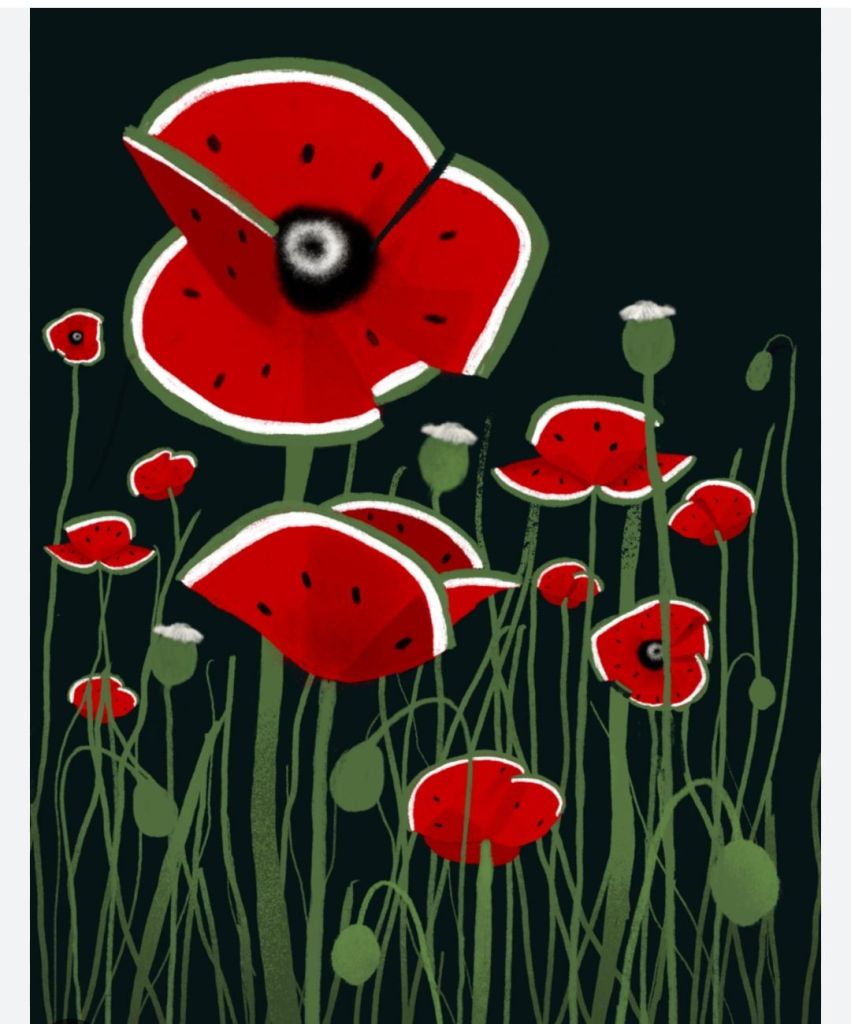
As the pageantry and performance of Remembrance day gets underway in the UK and in many of the Commonwealth nations (Countries Britain colonised and continues to exert soft power over) I thought today I would spend my time remembering the victims of the many wars Britain has instigated, partaken and benefitted from, since the end of The Great war. The bloodied hands of politicians lay wreaths and their mouths, from one side, utter empty phrases such as “never again”, and from the other, actively support and fund at least two current genocides (Gaza and Sudan) that we know of. When will we tire of the theatrics of “lest we forget” and demand actual accountability?
Remembrance Day is supposed to honour armed forces members who have died in the line of duty. There are over 100,000 war memorials in the UK, many marked with a cenotaph, where wreaths are laid. Cenotaph is from the etymological root of the Greek words kenos taphos and literally translates to “empty tomb”.
During the First World War approximately 5 million British soldiers signed up to take part in the war efforts. There are no exact figures from the Commonwealth nations but its estimated to be around 3 million, with almost half the figure coming from India (which at that time included present day Pakistan and Bangladesh) During the Second World war the number of British soldiers had dropped to 3.5 million whilst the numbers fighting from the Commonwealth had increased to over 5 million. Indian troops, many of whom were Muslims, made up over half the volunteer soldiers. They fought on many fronts, including at North Africa, South East Asia, the invasion of Italy and the Middle East. 40,000 Indian servicemen also provided crucial support for the British Merchant Navy. Around 87,000 Indian soldiers were killed during the war. In 1943, during the war, there was a famine in Bengal in which over 3 million people died from starvation and disease. The famine was exacerbated by the British, led by Churchill, choosing to divert resources to the UK and Europe and letting the Indians starve. India not only sacrificed its people for the war effort, it also funded it with its resources and taxes.
Within the last 30 days we have had both a far-right fascist march, demanding the end of immigration and keeping Britain white, and now Remembrance Sunday, where we allegedly remember the sacrifices made by the armed forces so we can enjoy our freedoms today. Most of those unnamed soldiers were from the Commonwealth, volunteers who gave their lives protecting this nation. The irony of remembering the fallen whilst actively campaigning to rid these shores of the descendants of those who built this country, with their blood and toil, is obviously lost on those wearing poppies and laying wreaths today. It is an indictment of the education system, our media and the morals and values of this broken nation.
This year marks 80 years since the end of the Second World War. According to a Declassified UK report from January 2023 (before the Genocide in Gaza) Britain has deployed its armed forces for combat over 80 times in 47 countries since 1945. From overt invasions, such as the bombing and occupation of Afghanistan after 2001 and the 2003 invasion of Iraq. The UK intervened at least four times in British Honduras (which became independent as Belize in 1981) to deter Guatemala from its claims over the territory. They also armed and supported attempts to overthrow governments such as in 1964, British forces put down army mutinies in three countries in East Africa – Kenya, Uganda and Tanzania – to shore up pro-British governments just after they had become independent. The brutal colonial counter-insurgency wars of the 1950s and 1960s – in Kenya, Malaya, Aden and Cyprus – involved the widespread use of torture and, often, pernicious operations to displace large numbers of people to control the local population. They were also involved in covert missions such as those in Indonesia in 1950s in an attempt to promote a rebellion against nationalist president Sukarno – and in the 1960s in Yemen – in a war to bog down the forces of Egypt’s leader, Gamal Abdel Nasser, in which tens of thousands of people died,
Not only is the UK involved in constant conflicts it is also financially benefitting from them. The UK is one of the world’s largest arms exporters. Between 2010 and 2019, almost 60% of UK arms exports went to the Middle East, mostly to Saudi Arabia. UK-made weapons have been used in the Saudi-led bombardment of Yemen, and the UK government has provided ongoing maintenance and technical support for Saudi aircraft. More recently it has been condemned for supplying F-35 fighter jet parts to Israel, a country being investigated for genocide by the international criminal court. 80 years after the Holocaust in Germany, the UK is actively involved in another Holocaust, this time in Gaza.
It is audacious of politicians, many of whom are lining their pockets from the wealth of war, to preach history to us, as if in the age of information, we might still believe in their performances of humanity. There is absolutely no excuse for us to show apathy either. People, from across the Commonwealth, fought and died for this country. It was the bodies of our people who made up the bulk of the British Army. They not only fought, they built, they nursed and they laboured to make everything that makes Britain Great. There is not a street or building, bridge or train track, factory or industry, in this nation that hasn’t been laid, or paid for in some way, by the wealth stolen for the countries that Britain colonised. This land is our land, build on the backs of our people, who we will always welcome here. We will never forget.
 This Hybrid Reads