When I saw the protests at the Port of Dover, the images of men covered from head to toe in black paramilitary gear, marching in the streets and blockading roads, my instant reaction was a mixture of shock, horror, and condemnation. I thought to myself: Who are these people, and why is hatred their hill? Yet, dismissing them as fringe vigilantes acting outside of civil society allows the rest of us to escape self-examination. In reality, these men are simply the hyper-exaggerated, visceral manifestation of a state-sanctioned nationalism that the modern world has normalized.
Unable to sleep later that night, I was scrolling through Instagram when I noticed just how rife and insidious this identity-policing has become on social media. I was particularly triggered by a comment section debating why Desi Muslims try so hard to be “Arab,” citing examples like using wallahi instead of kasme, or wearing a thobe rather than a shalwar kameez. This digital boundary-keeping mirrors the physical policing at the border; both are rooted in a desperate desire to cage fluid human experiences into rigid, artificial categories. Cultures are inherently fluid, and those of us in the diaspora do not belong to just one culture, especially across generations. This obsession with geographic purity is precisely why so many of us face a painful, perpetual struggle with belonging.
Even first-generation immigrants often flee nations that are themselves scarred, unstable products of colonial engineering. Take the partition of South Asia, which birthed Pakistan and Bangladesh—nations that are, in the grand scale of human history, a mere 79 and 54 years old respectively. My own maternal grandmother’s life completely defies these modern borders: born in British India, she migrated to Pakistan, and now resides in Kashmir. One woman’s lifespan has traversed three spaces, each possessing distinct cultural identities and multiple languages, yet her humanity remains whole. My mother was born in Pakistan and moved to the UK at twenty, living here until she passed away. What, then, does that make me? I am married to a Bengali; how should my children identify?
The universal human need to be seen and to have somewhere to call home is fundamental to our psychology, but our identities should never be chained to lines drawn on a map by imperialists. From America to India, and right back to the tarmac in Dover, nationalism is a disease. The earth is vast, and it belongs to all of us. The most devastating example of this geopolitical sickness today is the Israeli settler-colonial project. Built on the nationalist myth that land inherently belongs to one specific group over another, it violently erases the indigenous Palestinians of all faiths and none. Just because the British Empire mandated the partition of the land to erect a new nation-state called “Israel” on an already populated country does not grant it an unassailable right to exist. Like any nation-state, it is a man-made construct. And like any construct, it can, and must, be deconstructed.
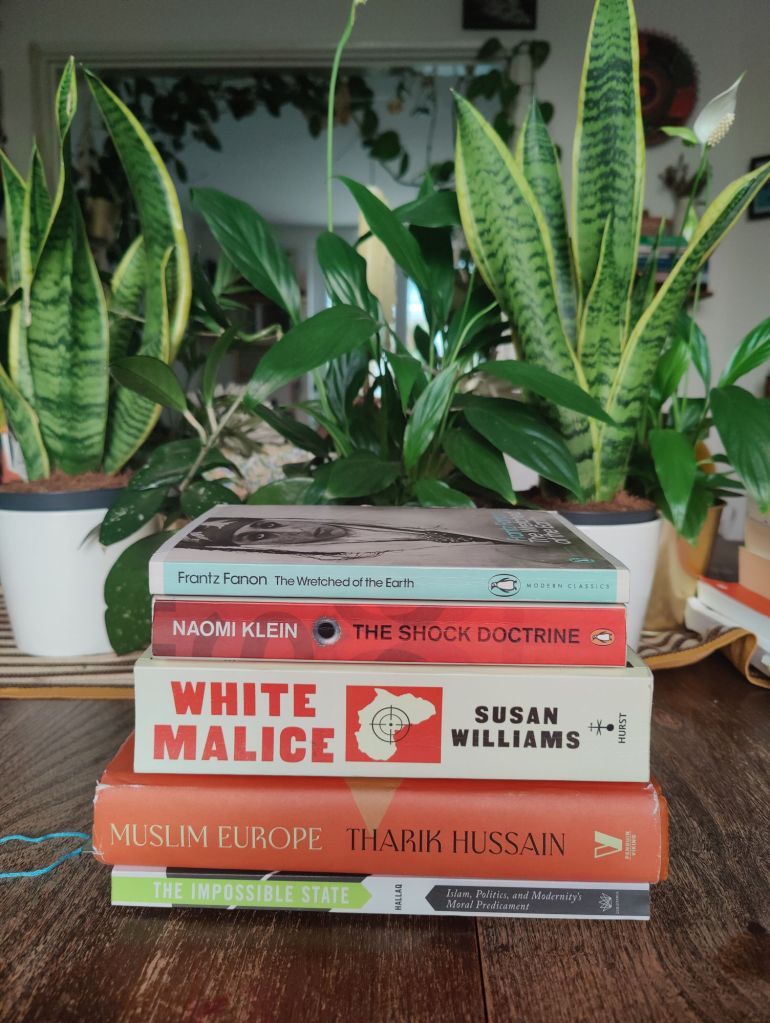
This personal crisis of displacement forces me to look beyond modern political maps and ground myself in my strongest, most unshakeable affiliation: I am a Muslim woman. Within Islamic thought, identity is liberated from the cage of nation-states. Historically, the Muslim world operated as a vast, interconnected tapestry where a scholar or traveller could seamlessly journey from the courts of Madina to Damascus, and all the way across to the scholarship hubs of Senegal, completely unhindered by passports or checkpoints. These historical Islamic empires were deeply diverse, pluralistic landscapes that functioned, for the most part, as safe, multicultural spaces for residents of all faiths and none. As author Tharik Hussain uncovers in his ground-breaking book Muslim Europe, this inclusive legacy was woven directly into the fabric of the West. Hussain’s travels through places like Sicily, Malta, and Spain expose a rich, forgotten history of a “Muslim commonwealth” where European Sultans and Arabic-speaking Christian kings coexisted. This cross-fertilization of faiths and cultures proves that human society flourishes not when we segregate ourselves behind militarized borders, but when we build open systems of mutual exchange.
A contemporary attempt to replicate this borderless fluid movement can be seen in the structural architecture of the European Union. As an idea, the EU’s concept of free movement is magnificent; it acknowledges the basic human need for mobility and economic fluidity. However, in practice, its execution exposes the deeply racist underpinnings of Western geopolitics. The EU treats free movement as a premium privilege reserved exclusively for white, European bodies, while simultaneously fortifying its external borders into a deadly “Fortress Europe” designed to keep Black and Brown migrants out. This hypocrisy brings us right back to the tarmac in Dover. The modern world is obsessed with defending the sanctity of borders that were originally constructed to colonize the global majority, while destroying the ancient, borderless models of hospitality that once allowed humanity to truly belong anywhere
The Quran teaches us explicitly to reject tribal pride and teaches that personal character, not race, nationality, or language, is the only true measure of human value.
Modern political nationalism fundamentally clashes with Islamic principles because it replaces the universal brotherhood of faith (Ummah) with rigid geopolitical borders, prioritizing national identity over shared moral and religious bonds. While Islam teaches that national and ethnic differences exist purely for mutual recognition and that human value is measured solely by righteousness, nationalism often fosters a form of modern tribalism (‘asabiyyah) that demands absolute loyalty to the state above all else. This creates a theological conflict, as it can elevate national self-interest above universal justice and religious duties, effectively replacing devotion to spiritual principles with allegiance to a secular political construct. Examples of this can be found in the works of Wael B. Hallaq.
While international sporting events like the Olympics and the FIFA World Cup are celebrated as symbols of global unity, they often mask more insidious undertones by serving as powerful engines for modern nationalism. Beneath the spectacle of athletic excellence lies a structured system that forces individuals into rigid national categories, turning a seemingly harmless pastime into a breeding ground for state-sponsored rivalry. This environment subtly conditions people to view the world through a fiercely competitive, tribal lens, where national pride is directly tied to dominance over others. When the collective emotional energy of millions is funnelled into flag-waving and anthems, it does not bridge gaps; instead, it reinforces the exact artificial divides and ideas of national superiority that Islamic principles explicitly reject in favour of a universal brotherhood
This rejection of national borders becomes even more poignant when analysing how many modern nation-states are actually artificial, post-colonial constructs rather than organic communities. The partitions that birthed nations like Pakistan and Bangladesh, alongside the arbitrary borders carved across the African continent, created fragmented identities that frequently resulted in political instability and ethnic strife. Rather than being allowed to naturally heal or deconstruct these colonial scars, the development of these fragile states was systematically targeted by foreign intelligence operations. As Susan Williams details in White Malice, the CIA covertly worked to strangle genuine autonomy in post-colonial Africa by destabilizing independent nationalist leaders, such as Patrice Lumumba in the Congo, to ensure Western alignment and resource control. Once these societies were sufficiently destabilized, they became highly vulnerable to what Naomi Klein terms the Shock Doctrine. Klein illustrates how foreign powers and economic institutions exploit periods of extreme national trauma, wars, or coups to forcefully implement hyper-capitalist, neoliberal reforms before the disoriented populace can resist. Ultimately, these manufactured nationalisms and subsequent foreign interventions serve as an insidious feedback loop: western intervention fractures the global community, and the resulting artificial state-worship keeps populations divided, perfectly mirroring the destructive forces of tribalism that Islamic principles seek to dismantle.
The insidious undercurrents of this manufactured state-worship are not just historical artefacts or distant foreign policies; they manifest actively on our own doorsteps, as seen in the anti-immigration protests at the Port of Dover. It is easy, and perhaps comforting, to judge the masked, black-clad men blockading the roads and dismiss them as far-right extremists or fringe actors. Yet, strictly doing so allows the rest of society to escape self-examination. In truth, these overt displays of xenophobia force us to hold up a mirror to our own internalized, passive nationalism, a nationalism that many of us quietly harbour even for countries we were not born in or do not currently inhabit. By participating in a culture that treats borders as sacred and views human migration as an inherent threat, we inadvertently validate the very logic of exclusion that the men in Dover aggressively champion.
This exclusion cuts directly against the psychology of belonging and the fundamental human need to have somewhere to call home. For members of the diaspora, particularly Black and Brown people who may have lived in the UK their entire lives, this man-made hierarchy of belonging creates a painful, perpetual alienation. Despite holding citizenship, paying taxes, and building lives within these borders, people of colour are constantly “othered” purely due to the colour of their skin. They are trapped in a exhausting limbo: never deemed truly British enough by the dominant culture, yet fundamentally disconnected from the ancestral homelands fractured by the history of Western imperialism.
To understand the profound psychic damage of this existence, one must evoke the revolutionary psychology of Frantz Fanon. In Black Skin, White Masks, Fanon masterfully diagnoses how the institutional white gaze “fixes” the person of colour, reducing their entire identity to an inescapable somatic envelope. Under a nationalist framework, the person of colour is denied true subjectivity; they are constantly forced to negotiate their existence against a colonial metric of acceptance that they can never truly satisfy. Fanon illustrates that nationalism is not just a political ideology, but a psychological weapon that inflicts a severe inferiority complex upon the marginalized, compelling them to adopt “other selves” just to survive. Ultimately, by combining Fanon’s insights with the Quranic rejection of artificial tribalism, it becomes clear that true liberation requires dismantling the psychological and physical borders of the nation-state entirely, replacing them with a global community rooted in uncompromised human dignity.
Book Recommendations
The Shock Doctrine by Naomi Klein
The Impossible State by Wael B. Hallaq
Muslim Europe by Tharik Hussain
The Wretched of the Earth and Black Skin White Masks by Frantz Fanon
White Malice by Susan Williams

