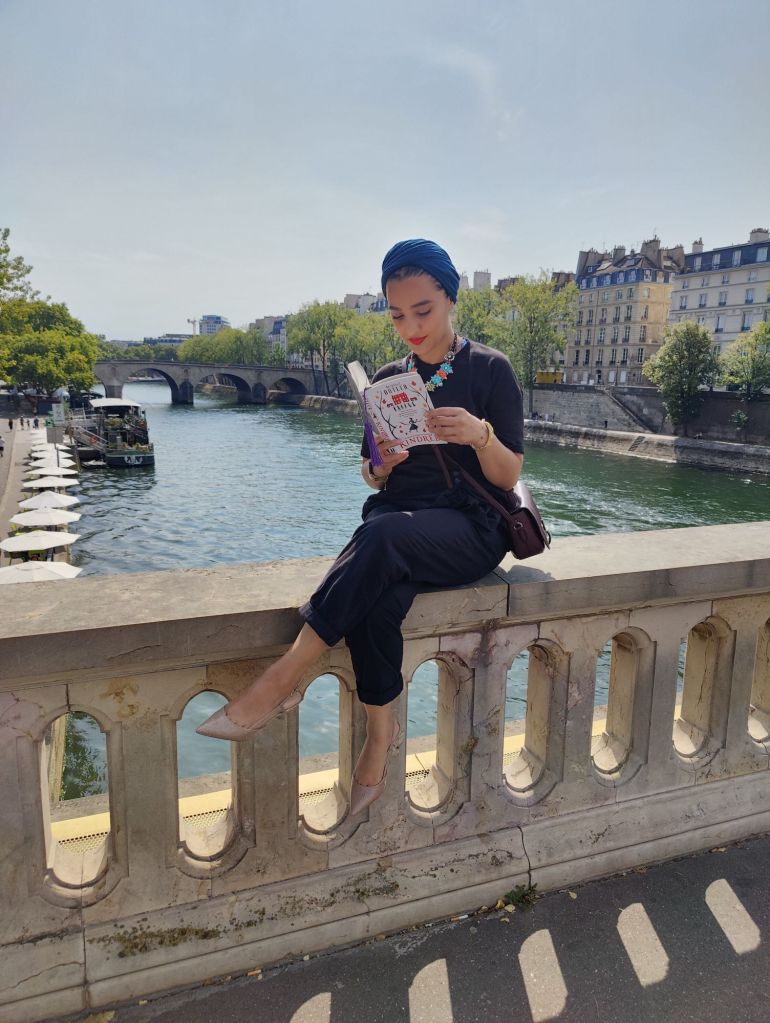
Let us unlearn a lie that has been packaged as enlightenment for centuries.
We are taught to look at a Muslim woman who chooses to cover her hair and see an object of pity. We are told by mainstream media, by Western feminists, and by the architects of modern secularism that her veil is a symbol of subjugation. They insist she is hiding, suppressed under the heavy, suffocating weight of the male gaze. But history, scripture, and the raw lived reality of millions of women tell a radically different story. The hijab has never been about the male gaze, and it has never been a submission to man. It is an architecture of female emancipation, a quiet but burning protest against the idea that a woman’s body belongs to anyone but herself and her Creator.
At its absolute core, the hijab is a quiet act of worship, a deliberate movement of devotion directed solely toward Allah. It is a private covenant, not a public debate. It completely transcends the material world, shifting the focus away from the physical, commercialised self and anchoring it firmly within the spiritual. In a global culture that consistently hyper-sexualises, judges, and commodifies women based on their physical appearance, the hijab operates as a radical reclamation of autonomy. By concealing her body from public consumption, a woman decides exactly who gets access to her physical form. She strips away the power of the external gaze and dictates her own terms of engagement: the world must interact with her intellect, her character, and her soul, rather than her physical attributes.
To understand why the secular world remains so obsessed with unveiling Muslim women, we must look at the footprints of empire. When the British Empire consolidated its grip on India, colonial administrators looked at Muslim women with a mixture of disdain and deep, psychological insecurity. They marched in under the banner of a “civilising mission,” claiming they needed to save brown women from brown men. But the archives reveal a much thornier truth: the British hated the realization that the Muslim women they sought to “save” already possessed structural legal rights that white women back in England could only dream of.
Long before the British arrived, Islamic jurisprudence, stipulated directly in the Quran, guaranteed Muslim women financial and legal autonomy. They had the right to inherit property independently. They had the right to initiate divorce. They maintained their own financial identities, keeping their wealth entirely separate from their husbands. Meanwhile, back in Victorian England, a white woman was legally the property and possession of her husband under the laws of coverture. She could not own property, she could not easily divorce, and her very legal existence was erased upon marriage. The coloniser wanted to control women’s bodies just as he wanted to control the land. To mask their own domestic backwardness, the British codified local patriarchal customs, actively stripping Indian Muslim women of their Quranic inheritance rights to simplify imperial tax systems. They systematically institutionalised rules and social structures that ensured Muslim women could no longer participate in public life, education, or governance if they chose to cover. It was never emancipation; it was an imperial erasure of existing female authority.
The dangerous echoes of that colonial engineering are ringing loudly across the world today. We see modern Europe hurtling right back toward its dark colonial past, attempting to colonise women’s bodies once more through legislative bans, public policing, and cultural exclusion. Western institutions are deeply frustrated that Muslim women, despite having access to all the secular “freedoms” of the West, still consciously refuse to let society gaze upon their bodies. The establishment is maddened by the sheer audacity of these women who claim their bodies as entirely their own, fiercely rejecting the mandate to become mere commodities for sale at the capitalist marketplace of the Global North. Yet, the tragic truth is that while the West obsesses over regulating the modest clothing of Muslim women under the guise of “saving” them, it consistently turns its back on the epidemic of violence destroying women within its own borders. The illusion of Western safety is shattered by the horrors of our present day, from the systemic failures of the Cornell 7 case to the chilling reality of France’s mass rape trial, where Gisèle Pelicot was systematically drugged by her own husband and sacrificed to the violence of dozens of strangers. In the United Kingdom, domestic abuse remains a catastrophic crisis, buried under a culture where crimes against women are routinely under-reported and left unsolved, and where structural violence is so deeply normalized that a Reform MP, Sarah Pochin, could casually urge the England football team to “keep winning” just so the women of England would not get beaten up by their partners. When women in the West are crying out for systemic justice, protection, and fundamental safety, the state turns a blind eye, proving that the obsession with the hijab has never been about liberation. It is a calculated distraction, a smoke screen designed to mask the rot of a society that claims to champion female freedom while failing to protect women at the most basic level.
This colonial obsession with the veil repeated itself across empires, captured perfectly by Frantz Fanon in his analysis of the French occupation of Algeria. The French military and political machine became utterly obsessed with Algerian women, believing that to break the spine of Algerian resistance, they had to unveil them. They wanted to gaze upon them, to Westernise them, and to possess them visually and culturally. Yet, the veiled Algerian woman completely frustrated the coloniser. Fanon wrote beautifully about the psychological paralysis of the occupier when faced with a covered woman. The veil created a devastating one-way mirror. The Algerian woman, moving through the streets of Algiers, could see the Frenchman perfectly, observing his movements, his anxiety, and his arrogance. But the Frenchman could see nothing. He was met with an impenetrable cultural barrier. Instead of feeling like dominant conquerors, the French felt exposed, rejected, and entirely excluded by the very people they claimed to rule. The veil became a political weapon, a boundary that told the empire they could occupy the land, but they could never occupy the women.
The secular world speaks of the hijab as if it is an entry barrier to modern civil life, conveniently forgetting that Muslim cultures across the globe, since the time of the Prophet Muhammad (peace and blessings be upon him), have flourished through female scholarship, physical courage, and structural equality, all while women chose to cover. We look back to Aisha bint Abi Bakr, one of the greatest legal minds and transmitters of Islamic knowledge, and to Fatima al-Fihri, the visionary who founded the world’s oldest continuously operating university in 859 CE. We remember Nusaibah bint Ka’ab, the fierce female warrior who picked up her sword on the battlefield of Uhud to protect the Prophet, embodying the ultimate synthesis of physical bravery, spiritual devotion, and bodily sovereignty. Islamic history is firmly anchored by these women who wore the hijab and led societies. Today, that legacy hasn’t changed; it has only multiplied.
Women in hijab partake in every single aspect of human life, refusing to sit on the sidelines of history. They govern nations, rule kingdoms, and run their homes with equal sovereignty. They run hospitals, head prestigious universities, and command research in cutting-edge nuclear laboratories. They are boundary-breaking entrepreneurs, corporate CEOs, and visionary philanthropists. Look to the horizons and you will see them diving deep into the oceans, climbing the highest mountain peaks, and soaring into the skies as pilots and astronauts. They play football, dominate basketball courts, tackle on rugby pitches, glide across ice rinks, and play polo. They are brilliant artists, pioneering engineers, and software developers. They are the bedrock of our societies: mothers, sisters, daughters.
Muslim women are not asking for permission, nor are we asking for rescue. We do not demand anything from anyone. All we want is to wear our hijab, in any style we choose, whether wrapped loosely, pinned meticulously, draped elegantly, or worn as a radical political statement, and to be left in absolute, uninterrupted peace. The hijab is not a symbol of what a woman cannot do. It is the uniform of a woman who knows exactly who she is, who her Creator is, and who refuses to let a commercialised, hyper-sexualised world dictate her worth. It is time the world stops trying to save women who are already entirely free.

