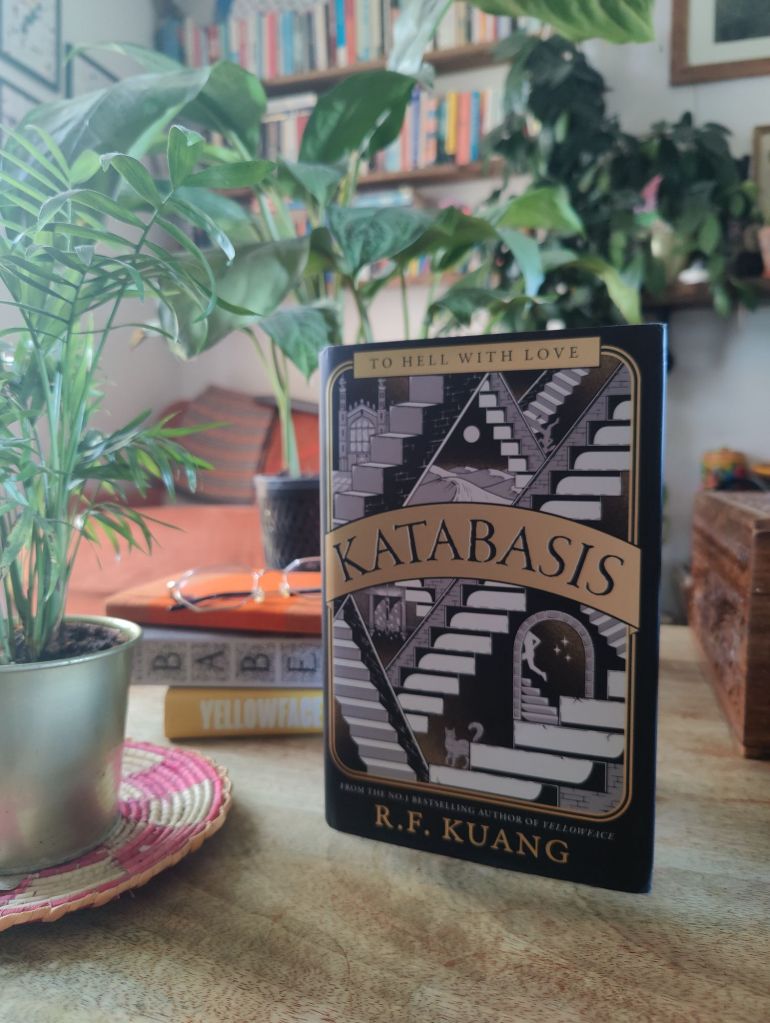
I made the mistake of visiting Goodreads before reading Katabasis to look at some reviews. It’s a massive book and I wasn’t sure I wanted to commit myself to something based on Dante’s Inferno. As a Muslim reader the poem is deeply offensive and reflects the hostile, anti-Islamic sentiments of medieval Christian Europe. I wasn’t worried that Kuang would imitate Dante by placing the Prophet Muhammad (Peace Be Upon Him) or any of the other great Muslim scholars and leaders, such Ali Ibn Talib (may Allah be pleased with him) or the philosophers Averroes (Ibn Rushd) and Avicenna (Ibn Sina), or even Salahudin a military leader, into one of the circles of hell, I just wondered if the concept would hold my attention. Having read both Yellowface and Babel, I wanted to believe that this too would be an intriguing and insightful work of literature in the the hands of such an iconoclastic writer. And for the most part, I think it did.
The criticism I read online went from fair to absurd in record time. A certain demographic took offense at not being able to relate to the main character, Alice Law, as her hair colour wasn’t revealed early enough! Others bemoaned how densely academic it was calling it “pretentious”. I had to wonder if these readers also found authors like Donna Tartt, Susanna Clarke, A.S. Byatt pretentious, or even Dante himself? I personally didn’t think this was the case. I definitely didn’t understand all the references and to be honest most of the time I didn’t care enough to look them up, but overall I thought it was really well researched and an interesting culmination of Greek tragedies, philosophical ideologies and magical theory. Maybe because I’ve been reading the Harry Potter series with my children all year, I was open to all of these, particularly the magic!
The book is set in an alternative universe, where everything is the same and magic is real. Alica Law is a brilliant Chinese-American PhD student at Cambridge, who is on the cusp of handing in her PHd thesis when her professor Jacob Grimes dies. So naturally Alice has to venture into hell, accompanied by her main rival, Peter Murdoch, to bring her professor back in order to graduate. What could go wrong?
Katabasis is an ancient Greek term which literally means “descent”. In classical mythology it refers specifically to a living person traveling to the realm of the dead. In psychology, particularly in the work of Carl Jung, Katabasis refers to a “dark night of the soul” – a psychological collapse, or a journey into the subconscious mind where a person must face their darkest fears before they can experience a spiritual rebirth or breakthrough. What I particularly enjoyed about this “descent” into the underworld was the exploration of women in academia. It was so far removed from the usual heroic and noble tropes, and instead held up a mirror to elite universities, especially their treatment of women, and the psychological impact of perfection and chasing academic accolades at the expense of all else.
For me, the best thing about Katabasis was its incisive and deeply unsettling critique of how higher education exploits and breaks its most vulnerable students. As a woman of colour navigating a PHd in Cambridge, Alice faces a unique, intersectional type of marginalisation where her identity is treated as a dangerous variable she must constantly calculate and manage. Kuang perfectly captures the exhaustion of the “impossible mean”—the structural pressure on female academics to perform a flawless balance of modesty and intellect just to be taken seriously. But where the book truly hurts is its depiction of institutional racism, which manifests not through explosive prejudice, but through the cold weaponization of the “model minority” myth. The faculty expects Alice to function as an uncomplaining, industrious machine, a double standard that her white male rival, Peter Murdoch, effortlessly avoids. Alice, an international student, becomes hyper-vulnerable to the grooming of her abusive advisor, Professor Grimes. Because the colonial architecture of the university intentionally keeps resources scarce, Alice is conditioned to view other students not as allies, but as direct threats in a brutal survival game. The psychological impact is devastating: Alice doesn’t dismantle this patriarchal, toxic system; she survives by absorbing its cruelty.
I don’t especially need my protagonists to be likable, and Alice’s tunnel vision and sheer determination of a single goal at the expense of all else (she literally travels to hell to get her PHd) made her fascinating. If anything, I felt sorry for her because I felt seen by her. Not necessarily in academia, but through the heavy burden of being the “model minority”—always having to represent, while carrying the weight of history, shame, and the desperate desire for acceptance.
The character of Professor Helen Murray was particularly interesting to me as she served as a sharp indictment of institutional “white feminism” and the devastating failure of true gender solidarity within academia. When Alice is navigating an intensely isolating environment following the disclosure of a sexual assault, she turns to Helen, expecting to find safety and an ally. Instead, Helen entirely dismantles any hope of solidarity. Despite spearheading the university’s women’s movement, Helen behaves problematically by gaslighting Alice—insinuating that she brought the assault upon herself and mocking her efforts to blend into the male-dominated department. Helen advises Alice to simply endure the abuse quietly and move on so as not to cause an institutional disruption. By prioritizing the protection of the university’s reputation over the safety of a vulnerable woman of colour, Helen demonstrates how “white feminism” often serves the status quo. Her actions highlight the book’s darker thesis: that mainstream academic feminism is often an insular club that fails to protect marginalized women, actively driving outcasts like Alice to reject solidarity entirely and rely on absolute ruthlessness to survive.
For me the only thing I found a little jarring about the book was the ending. For over four hundred pages, R.F. Kuang masterfully builds a cold, clinical world where magic is powered by mathematical logic and the stakes are entirely defined by the devastating trauma of academic ambition. However, the climax completely undercuts this momentum by suddenly pivoting away from systemic survival and towards the power of romantic devotion. By shifting the focus to a “love conquers all” moral, the narrative relies on an unsatisfying emotional shortcut that feels entirely forced. Instead of committing to the grim, cynical, and isolating reality of Alice’s academic ambition and the heavy themes of misogyny, abuse, grooming and oppression, the book opts for a trite resolution that feels disconnected from the story’s initial dark academia edge.
Despite a disappointing pivot in its final pages, Katabasis remains a deeply necessary, razor-sharp addition to the dark academia genre. R.F. Kuang continues to prove that she is an expert at pulling back the curtain on prestigious institutions, forcing readers to look at the ugly machinery underneath. It is a haunting, brilliant, and deeply uncomfortable mirror to hold up to higher education—even if the ending blinked first.
Now, I want to hear from you: Have you read Katabasis yet? If you’ve read Kuang’s other works like Babel or Yellowface, how do you think this one compares? Let’s talk about it in the comments below!

