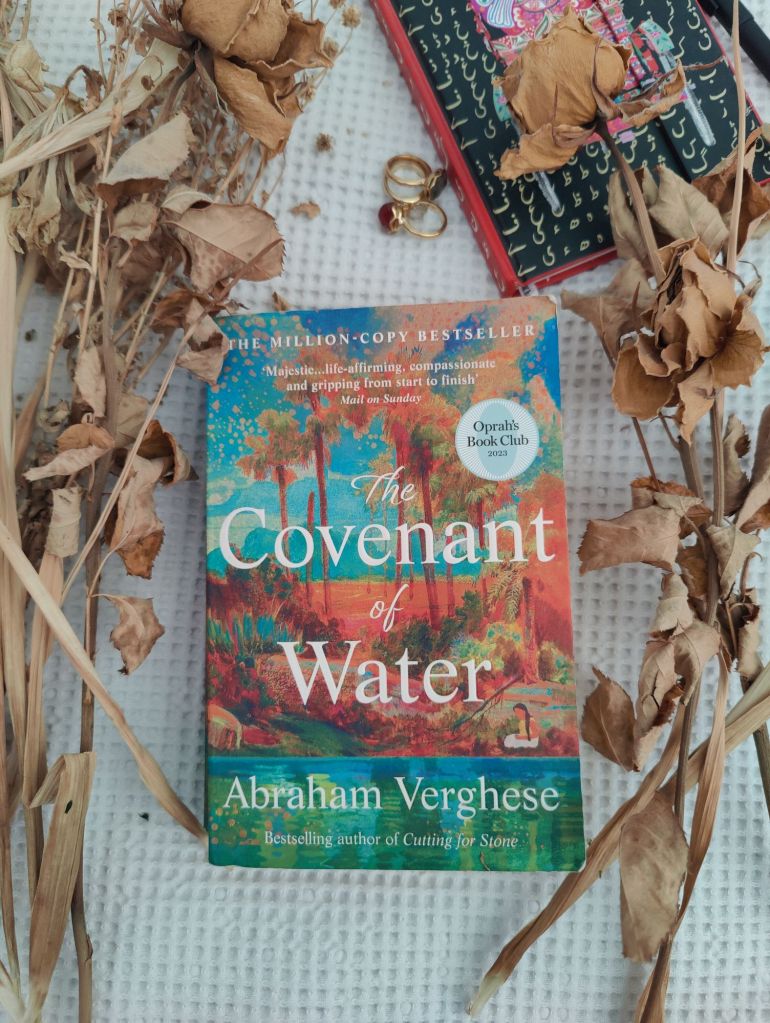
I know this will make me unpopular with the girlies, but I just didn’t love this book. Don’t get me wrong, it’s a good read, it’s ambitious and it’s lyrical, but it didn’t have me breathless in the way I was expecting.
Everything was a little bit too neat for me, all the characters just too saccharine.
I’m not suggesting this is a bad book, it’s just a very convenient story, the good people are extremely good, the tragedies are tragic and even the British during colonial rule come off favourably . There is a sentence mentioning the Bengal famine and another about the actual partition, but it’s as if the ripping apart of a nation is just incidental. Considering what the Empire did to the jewel in it’s crown, this book feels revisionist in its whitewashing.
I wonder what The Covenant of Fire would look like if Abraham Verghese wrote it with a real fire in his belly, not for the Opera book club, but the millions of South Asians in the diaspora, or the billions of people who survived colonial rule and its consequences?
It’s such an idyllic view of India, where lepers and untouchables live alongside white men and Brahmins, that it at times felt insincere. It’s full of magical realism and folklore, so maybe the author wanted to tell a beautiful story, but I wanted “It’s fiction! Fiction is the great lie that tells the truth about how the world lives!” It’s a shame for me the novel didn’t manage to live up to the central tenant of its own proclamation.
There’s a sentence, much later in the book, spoken by the character Lenin, “if the British hadn’t discovered tea, the mountains would be bald”. It’s an innocuous phrase if you don’t know the history of colonial rule in India. The British tore down native trees in order to plant their beloved tea plants, which were not native to the land and as a consequence had an impact on the ecosystem. Shashi Tharoor covers this in detail in his book “Inglorious Empire” if you want more details, but needless to say, the Indians in India didn’t reap the benefits of the tea plantations, they broke their backs working on them. Ironically Lenin is part of the Naxalites, a far-left Maoist movement that emerged in post-independence India.
By pushing Lenin into the radical, far-left Naxalite movement, the narrative flirts with the raw friction of India’s post-independence politics, only to quickly sanitise it with a neat, liberal democratic resolution that feels completely out of touch with the violent realities of systemic collapse. This sanitisation happens because the narrative treats systemic oppression and radical resistance as mere backdrop drama, choosing to resolve deep-seated colonial and caste traumas through individual medical triumphs and neat, moderate compromises rather than addressing actual structural upheaval. The novel suggests that the deep wounds of colonial rule and the caste system can be healed if individual good people (like doctors and benevolent landlords) just work together across social lines. It trades resistance for the sterile, comforting belief that a modern hospital, an elite education, and a moderate, law-abiding compromise can fix a fractured society. It lets the state, the empire, and the class system off the hook by wrapping the story up in a tidy, feel-good bow.
British rule in India was devastating as is the Caste system, and to pretend otherwise feels unauthentic.
This book is a love song to medicine, and occasionally it obfuscates healing as something only Drs do. As if resistance to occupation, to injustice, to inhumanity are somehow less healing than a scalpel and some pills. I think at this point I should add that my least favourite character in the book was Mariamma jnr. To me, she is the ancestors worst nightmare. In a book that covers the span of 100 years told through the lives of multiple people, it’s hard to really build characters, and I feel this is another one of the books weak points. Mariamma just felt so obscure and unrelatable to me. Her story is in the 1970’s, post independence, and her privileged life make her believe that being part of the system is the only way to fight for true justice, rather than, like Lenin, join a revolutionary movement. She tells him “you what to help the downtrodden? Be a social worker! Or go into politics. Join your bloody Party and run for office” as if the only fix to the system is from within.
I did love the descriptions of labour, particularly all the gory details. In truth I loved all the details of procedures, the various ailments patients presented with and the dynamics within the hospitals. This is clearly what the author loved and wrote with passion and nuance.
I also thought the metaphor of water throughout the book was brilliant, and how Verghese creates tributaries throughout the story and manages to connect them so beautifully to the central body of the book.
With 715 pages, The Covenant of Water is not a short book, and whilst its written beautifully, and spans a period of almost 100 years, there was a bit of a lull in the middle of the book for me before it picked up again near the end. Do I think it could be edited by at least a hundred pages, sure. Do I think it would change anything about the book for me, not really. I know not everyone wants to read books that devastate them, and truthfully, I don’t either. The balancing act between hope and despair is tricky, and the desire to create characters that are all perfect and likable, even in situations that are horrific, is understandable. But when it’s my history that is being rewritten it makes me feel uncomfortable, no matter how perfectly the prose sings.
Maybe this is the type of fiction that is simply that, completely made up, to make ‘us’ feel good, but I’m left with the uncomfortable feeling of not belonging to the ‘us’ in question.
Let me know if you’ve read The Covenant of Water and if you think I’m being unfair to a book that is clearly a labour of love and so well received by many readers.

