A review of Sally Rooney’s Intermezzo and its fluid, character-driven prose
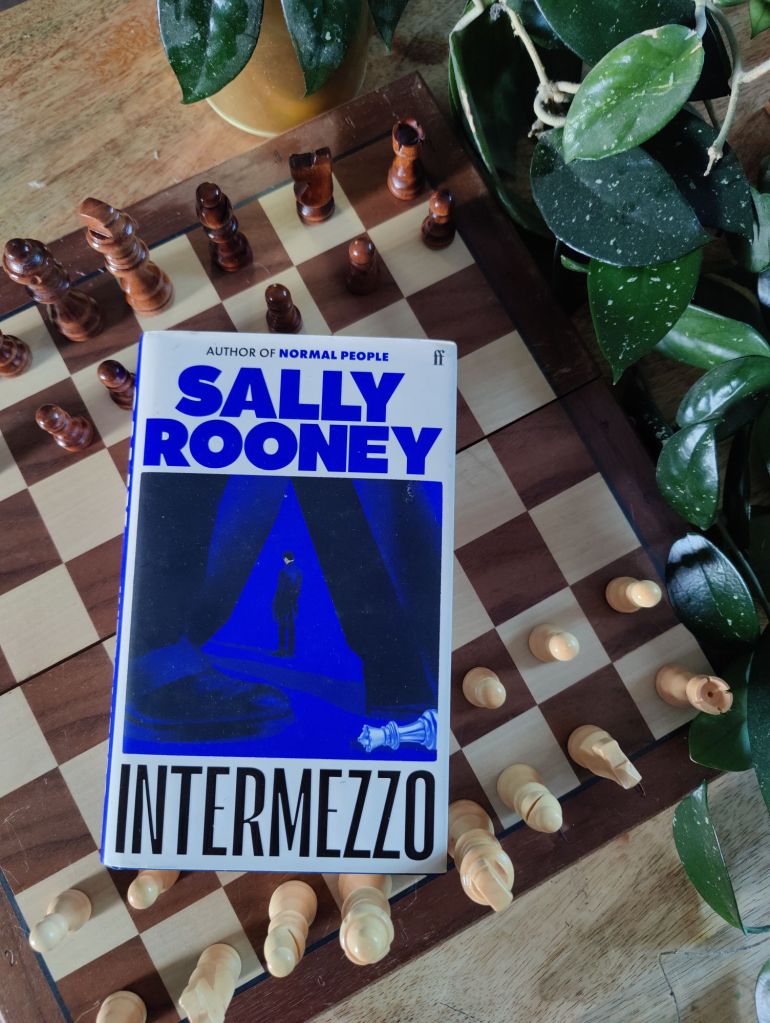
Let me confess right away that it took me a minute to get into Intermezzo. After reading the first chapter, I had to call my sister and ask her if it was worth continuing. At 43, I don’t allow myself to waste time with fiction that doesn’t sing to my heart. I love Sally Rooney and should have known that this initial hiccup was really a “me” problem and had nothing to do with the book.
Intermezzo is the story of two brothers navigating the grief of losing their father. Peter and Ivan couldn’t be more different. Peter, 32, is a handsome and successful lawyer. Ivan, 22, is a brilliantly smart, former child chess prodigy who—although never explicitly labeled in the narrative—is clearly neurodivergent.
“Intermezzo” is an Italian word meaning a short, connecting instrumental movement in an opera or musical work. In chess, it is a tactical move where a player interrupts an expected sequence to insert a surprise, forcing move—such as a check or a direct threat. I can’t think of a more appropriate title for this musical dance of a novel that plays out like a high-stakes chess match. Peter and Ivan are opposing pieces on the board, both battling out their grief silently. Even though they are presented as polar opposites—black and white—they navigate their lives in surprisingly similar ways, mirroring each other in their distinct successes and common failures.
Peter is naturally good with language and people. He knows exactly how to shift his style to suit his audience, and his success gives him an air of confidence and arrogance. Yet deep down, Peter is fraught with uncertainty. Ivan, on the other hand, battles with communication. He is literal, blunt, and struggles with social nuances. His internal monologues reveal his external awkwardness. And yet, as unsure as Ivan presents himself to the world, he has a profound clarity about who he is and what he wants.
What I thought was incredible about this novel was how the narrative shifts to suit the tone and character of each brother. In fact, the more I think about it, the more impressive I find Rooney’s ability to write in such fluid prose without compromising the integrity of the novel. It’s genius. It feels like walking around a gallery and sensing the eyes of a particular painting following you.
The book starts with Peter’s prose, which feels chaotic. Sentences are short and urgent, lacking verbs and pronouns. It was this style that I initially struggled with, but as I read on and got to know Peter, I recognized that this sharp, fragmented style mirrored his fraying psychological state perfectly. Ivan’s text, in contrast, is a lot more traditional. It is thoughtful and measured, mirroring his strategic, chess-playing personality. Although Ivan presents as socially awkward, he is comfortable with who he is, and that clarity is reflected in his warm, considered prose and his profound desire to understand people. I really enjoyed how Rooney created these two complex characters with such diverse and intricate internal dialogues, yet both are somehow unable to say what they really want or need. I read somewhere that her trademark lack of speech marks represents their shared inherited trauma and isolation—because spoken words look exactly like unspoken thoughts on the page.
I have a soft spot for books about siblings and families. Although there are romantic subplots, I deeply appreciated the novel’s exploration of duty, estrangement, and grief within the context of a family. I especially loved the way she explored how each sibling navigates his grief, and how complex and different the loss of a parent is for each of them. There is no one way to grieve, and throughout the novel, we see how their pain pulls them apart rather than bringing them together. Through their relationship, Rooney explores the uniqueness of the sibling experience: growing up together in childhood, and what happens to that bond when the family breaks up or when parents pass away. What does it mean to be biologically tethered to another adult when nothing else brings you naturally together?
The book also explores other themes, particularly around unconventional relationships and power dynamics. Personally, I think this is always a strength of Rooney’s work—how she interrogates our understanding of “normal.” In this book specifically, her choice of male protagonists and their vastly different internal monologues rationalizing their decisions against society’s expectations is brilliant.
Intermezzo isn’t a short or easy read, but it is an exceptional one. I found myself deeply invested in both brothers and in all the different threads the story pulled together. Sally Rooney is a master of her art, and this book is further evidence of her brilliance.
Have you read Intermezzo, or anything else by Sally Rooney? Let me know what you thought in the comments below!

