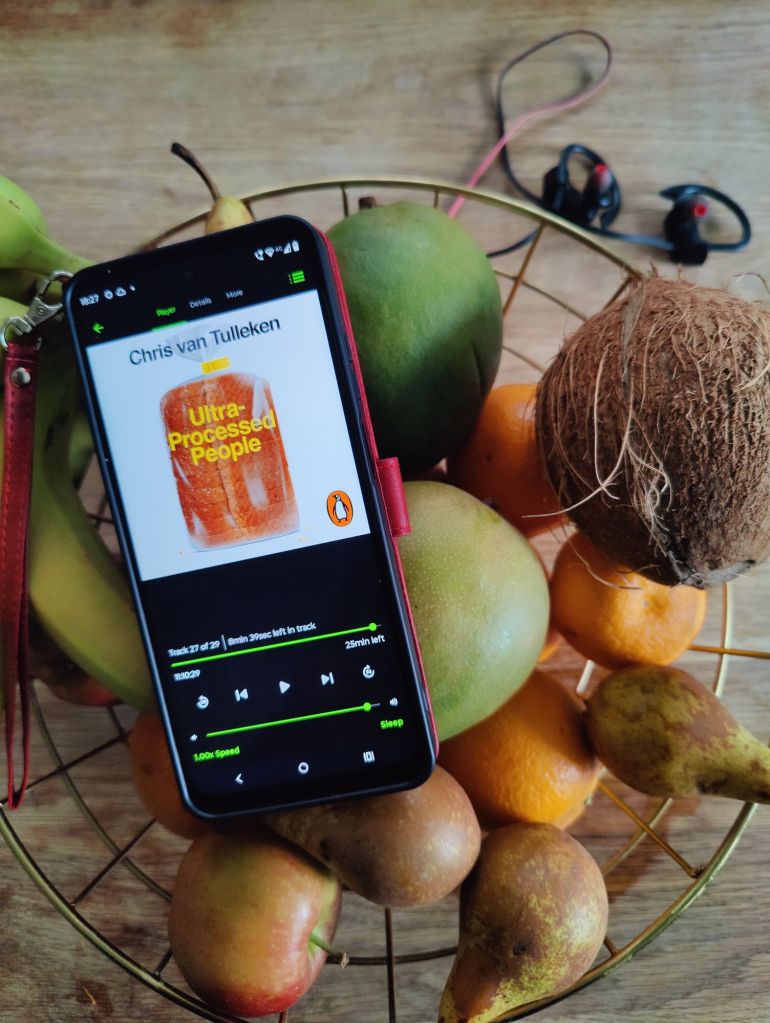
I’ve been wanting to read Ultra-Processed People from the moment I heard about it in early 2023. In fact, I was so eager I even DM’d the publishers for a review copy (the people at Penguin did not respond!). I did mange to get my hands on a physical copy some months later, but for one reason or the other, I didn’t read it. I should confess I’m obsessed with food and its culture. As a British-Kashmiri, food is a love language that is an integral part of my history and biology. So many of my favourite memories circulate around food, even more recent one, as my siblings and close friends have widened my taste and palate with their own curiosities, cultures and experiences. There is also an Islamic element to my relationship with food and my body.
As a Muslim, I believe that my body is an Amanah (a sacred trust from Allah) that must be nourished and protected, and my food choices should be an extension of my moral and spiritual character. Unfortunately, with the nature of our busy lives, this is not always the case. Islamic dietary laws dictate not just what is permitted but also its quality. Foods must be Tayyib, meaning pure, wholesome, and nourishing. Consuming permissible and clean food is believed to protect the body and heart, making one more receptive to spiritual worship, while consuming Haram (unlawful) food negatively impacts the soul and one’s deeds.
As you can see, this book fed into a number of my interests on the surface level, and as I started to listen to the audiobook, I found myself even more absorbed.
I will say that the book has a lot of science. Like A LOT! This might be the reason that I didn’t actually get into the physical copy when I picked it up 3 years ago. Of course, that should be expected as author Chris van Tulleken is a medical doctor who got his degree at Oxford University. He also has a PhD in molecular virology and is an academic researcher and this book is a result of his exploration of nutrition through the lens of institutional health and commercial industry practices, not as a dietitian or nutritionist. (He is also a TV presenter, and I know him best from hours of watching Operation Ouch! with my niece almost two decades ago!). I will confess that I found the science a little overwhelming in the physical book, however listening to the audiobook, narrated by Chris, it was absolutely fascinating. I found myself completely absorbed and sharing enthralling, and gross, facts in my family Whatsapp chat.
My favourite and quite possibly the most gut-churning experiment mentioned in the book is based on the work of German physiologist Paul Bert on rats in 1864. It was quite a rudimentary experiment, involving stitching two rats together to create a parabiotic pair. The subsequent experiments showed “one rat of the parabiotic pair was fed sugar while the other wasn’t. Both developed high blood sugar though of course only one developed tooth decay, showing that it was sugar in the mouth not the blood that rots teeth. In other experiments old mice were joined to young mice which extended the life of the older mice and shortened the life of the younger mice. As an aside, those experiments ultimately gave rise to a number of Silicon Valley startups that tried, unsuccessfully, to extend the lives of aging billionaires by giving them the blood of young people.” Nearly a century later in 1959 an English physiologist called G.R. Hervy began a series of experiments using the parabiotic paired technique to understand weight control. This time the rats had small electrical probes inserted into their skulls to damage their hypothalamus. (The hypothalamus maintains homeostasis in the body controlling temperature and water intake, how much you sweat and so on). What Hervey discovered was fascinating. The rats with the damaged hypothalamus lost control of their eating and quickly became obese. Some ate so much that they died by choking on their food, unable to detect the stop eating signals coming from their brains. “Meanwhile the other rat, entirely normal other than the fact of being attached to the rat with the hypothalamus lesion started wasting away. It was getting a signal through its shared circulatory system telling it to stop eating. This was the first strong evidence that there is a feedback mechanism for weight just as there is for every other system in the body”. The book uses this striking study to illustrate how hormones like leptin signal fullness and to demonstrate how modern ultra-processed foods can override these deep, biological feedback systems.
The NOVA classification system is a dietary tool that groups food into four distinct categories based on how much industrial processing it undergoes, rather than its traditional nutrient content (like fats, carbs, or calories). It was developed in 2009 by Professor Carlos Monteiro at the University of São Paulo, Brazil, and is the foundational scientific framework Chris van Tulleken uses throughout his book. While traditional nutrition science focuses strictly on counting calories, fats, or sugars, NOVA shifts the lens entirely to how a food is made. By categorising food into four groups based on its degree of industrial processing, NOVA provides the foundational definition for Group 4: Ultra-Processed Food (UPF). This distinction is vital to the book’s argument for a few reasons: NOVA highlights that industrial processing destroys the physical structure of food, creating soft, fibre-stripped products that bypass our biological fullness signals and drive overeating. Products such as low-fat yoghurts, protein bars, and plant-based meats often carry “healthy” labels. NOVA reveals these are actually engineered chemical formulations designed for corporate profit. Using NOVA, Dr Chris proves that modern health crises are caused by the addictive nature of food processing, not a personal failure of human willpower, as we are often marketed to believe.
One of the bravest things I think Chris does is question the ethics of research especially when it is presented as scientific fact. Throughout the text he takes apart research studies by exposing their connection to big business and multinational food conglomerates. He reveals how food industry interests heavily influence scientific research by funding studies that critique the NOVA classification system, which identifies ultra-processed foods (UPFs). By examining “Conflicts of Interest” disclosures, Van Tulleken exposes how researchers attacking UPF definitions often receive funding, grants, and consultancy fees from major food conglomerates like Nestlé. Chris argues that modern nutrition science is compromised by corporate funding, with food companies using funded research front groups, such as the British Nutrition Foundation, to mask marketing as independent health advice. He highlights how this bias shifts responsibility from governments and other regulating bodies from reducing the consumption of engineered, highly-profitable UPFs, towards blaming individual choices, exercise, or minor modifications to single ingredients. It also influences government dietary guidelines, and creates a funding bias that obscures objective health data, making industry-funded science a significant obstacle to public health.
I was truly alarmed to discover that almost 90 percent of hospital tooth extractions among children younger than five are due to preventable tooth decay. Furthermore, tooth decay is the number one reason that children in the UK have a general anaesthetic. The book also challenges the idea that people, especially those over 40, need to eat extra protein to build muscle, because muscles are made of protein, which according to Dr Chirs is “just complete rubbish”. This is due to the fact that the body can only absorb relatively small amounts of protein through the gut, “so unless you are powerlifting for many hours a day, you can get all the protein you need from just eating food. Normal food. Not UPF. You don’t need to eat muscle to build muscle, our bodies are clever enough to do what needs doing”.
The book challenges capitalist ideas of repackaging food as a lifestyle, rather than an essential requirement for life. Our bodies are now seen as machines, required to live forever and have ideal body types, read skinny for women and muscular for men. The “high performance fuel” we are sold is often ultra processed carbohydrate and proteins that are waste products of actual food processes, and as I learnt from the book, fodder for cows. Chris asks us to consider who is benefiting from our food purchases. If the answer is a food conglomerate than the chances are what’s on offer probably isn’t very good for you, regardless of how its packaged and marketed. As a general rule, if you can’t pronounce the ingredient, you probably should think twice about eating it.
I also love how Chris takes on big businesses. As if we needed any more evidence of the evil that is Nestlé, Coke, Pepsi, KFC, Unilever, Mars, Incorporated and Danone et al. the book provides detailed examples of how these companies have exploited communities, particularly in the global south. Interestingly all these companies are also on the BDS boycott list, but I digress. In part five of the book Dr Chris explores Nestle’s activities in Brazil and describes them as a form of “dietary colonialism” through the use of a “floating supermarket” boat, which delivered ultra-processed foods to remote Amazonian communities. By replacing traditional diets with highly engineered, addictive products (like Kit-Kat), the company caused a spike in childhood obesity and metabolic diseases in previously unaffected populations. Chris explores how the company displaced local culture, created economic dependency and extracted wealth from this already impoverished community. This of course is not new. The company has a long history of exploitation most notably in the 1970’s when it aggressively marketed baby formula to low-income countries and then diluted the formula with contaminated water which led to severe malnutrition, dehydration, and increased infant mortality.
Another reason why I would urge everyone to listen to the audiobook is the conversations between Dr Chris and his identical twin brother Dr Xander. They speak candidly about Xander’s struggle with his weight and Dr Chris’s own addiction to ultra processed foods which led to his experiment of eating an 80% UPF diet for a month to document how these “industrially processed edible substances” hack the brain’s dopamine pathways and cause dependence. Listening to the brothers’ conversations, with their intonations, and genuine affection and curiosity about each other’s experiences, added a warmth that I think might be lost in the physical book.
I also really appreciated the non-judgemental tone of the book. I really got the impression that this wasn’t about telling people to change their eating habits or their lifestyles, but really about making information available to people, and trusting them to make their own choices.
I really wanted to give this book all the stars but there was one thing that really disappointed me. In Chapter 11 Chris discusses a landmark study by American and “israeli” researchers on the impact of emulsifiers on gut health. If you’ve been here long enough you know this is a decolonial, anti-racist space. “israel” is a settler colonial state and as far as I am concerned, it needs to be shunned in every space: social, political, environmental, cultural and most definitely scientific. We know that “israel” experiments on Palestinians. Human rights organizations and international researchers widely document that Israel utilizes the occupied Palestinian territories as a real-world testing ground for advanced military weaponry, artificial intelligence, and surveillance technology. Throughout the book Chris speaks about the ethics of research conducted by people who have a dual interest or are being paid by a food conglomerate. Surely using research by a settler colonial state whose existence depends on the genocide of the indigenous Palestinian population should have raised an eyebrow.
Overall, I think this is a must read for anyone with even the slightest interest in food. It really isn’t about convincing people to change their diets, but more about informing us about the processes behind the production of foods. The audiobook is a great idea for those like me who are slightly intimidated by the science as it makes it so much more approachable. Like listening to a brilliantly well researched podcast.
Let me know if you’ve read Ultra Processed People and what you thought?
If you cook from scratch, what are your favourite go-to, quick meals that don’t involve processed ingredients?
Are you intimidated by science in books? Have you tried using an audiobook instead?

